

How Many Pages Are There in the Constitution of India?
F
Discover verified facts, data, and insights about India’s states, culture, economy, education, and more — all in one place at FactBharat.
Search for a command to run...
Discover verified facts, data, and insights about India’s states, culture, economy, education, and more — all in one place at FactBharat.
No comments yet. Be the first to comment.
Moving to the USA from India is a dream for many. Whether you want to study, work, or live with family, the process can seem complex. But with the right information, you can plan your move confidently. I’ll guide you through the key steps and options...
Opening a college in India is a dream for many educators and entrepreneurs who want to contribute to the country’s education sector. If you are one of those who want to start a college, you need to understand the process clearly. It involves several ...
Opening a hospital in India is a significant and rewarding venture. If you’ve ever wondered how to start one, you’re in the right place. Whether you’re a healthcare professional, entrepreneur, or investor, understanding the process is crucial. You’ll...
Opening a medical store in India can be a rewarding business opportunity. You get to serve your community by providing essential medicines and healthcare products. If you are thinking about starting a medical store, you might wonder where to begin an...
Opening a restaurant in India can be an exciting and rewarding venture. Whether you dream of serving traditional Indian dishes or international cuisine, the process involves careful planning and understanding of local regulations. If you’re ready to ...
FactBharat | Insights About India
2558 posts
Discover verified facts, data, and insights about India’s states, culture, economy, education, and more — all in one place at FactBharat.
On this page
The Constitution of India is the longest written constitution in the world, laying the foundation for the country’s democratic governance. It defines the structure, powers, and responsibilities of the government and the rights of its citizens.
But one common question people often ask is — “How many pages are there in the Constitution of India?”
The answer is:
The original handwritten Constitution of India contains 251 pages written on parchment sheets, while the printed version (English and Hindi combined) runs into around 1,170 pages in total, depending on the edition and publisher.
Let’s explore this in detail.
When India became a republic on 26 January 1950, the Constitution came into effect. It was not typed or printed — it was handwritten by calligrapher Prem Behari Narain Raizada in beautiful italic style on parchment (special handmade paper).
Number of Pages: 251 (handwritten)
Number of Articles (original): 395
Number of Schedules (original): 8
Adopted on: 26 November 1949
Came into Force on: 26 January 1950
Language: English (original) and later translated into Hindi
Weight: Approximately 3.75 kg
Ink Used: Made from gold and iron gall ink that lasts centuries
Preserved At: Library of the Parliament of India, New Delhi
Every page of the handwritten Constitution is artistically decorated with borders, symbols, and illustrations inspired by Indian cultural heritage — designed by artists from Santiniketan, under the guidance of Nandalal Bose.
The number of pages in the printed Constitution varies because different editions include amendments, annotations, and explanations.
Here’s a general breakdown:
| Version | Approximate Page Count | Details |
| Original Handwritten Constitution | 251 pages | Written in 1949 by Prem Behari Narain Raizada |
| Official English Printed Edition (1950) | Around 395 pages | Contained the original articles and schedules |
| Current Updated Edition (after amendments) | Around 1,100–1,200 pages | Includes all amendments, notes, and schedules |
| Hindi Edition (Bharatiya Samvidhan) | Around 1,200 pages | Includes same content translated into Hindi |
So, while the original document has 251 pages, the updated version with amendments now runs into over 1,100 pages.
The Indian Constitution is the longest in the world because it covers almost every aspect of governance in detail.
Federal System: Clear division of powers between the Centre and the States.
Detailed Rights and Duties: Comprehensive lists of Fundamental Rights and Directive Principles of State Policy.
Diverse Population: Special provisions for states, minorities, and tribal areas.
Borrowed Features: It combines elements from the constitutions of the UK, USA, Ireland, Canada, and Australia.
Administrative Complexity: Addresses governance at the union, state, and local levels.
Amendments Over Time: More than 100 constitutional amendments have been added since 1950.
These features make the Indian Constitution both detailed and adaptable.
The Constitution is divided into several parts, articles, and schedules that outline India’s political and legal framework.
| Component | Details (Original 1950) | Current (2025) |
| Parts | 22 | 25 |
| Articles | 395 | 470+ |
| Schedules | 8 | 12 |
| Amendments | — | 106 (as of 2025) |
Every amendment adds new pages to the printed version, expanding its total size.
The original document is not just a legal text — it’s a masterpiece of Indian art and calligraphy.
Each part begins with an illustrated leaf depicting a scene from Indian civilization (e.g., Vedic period, Mauryan era, Mughal rule, freedom struggle).
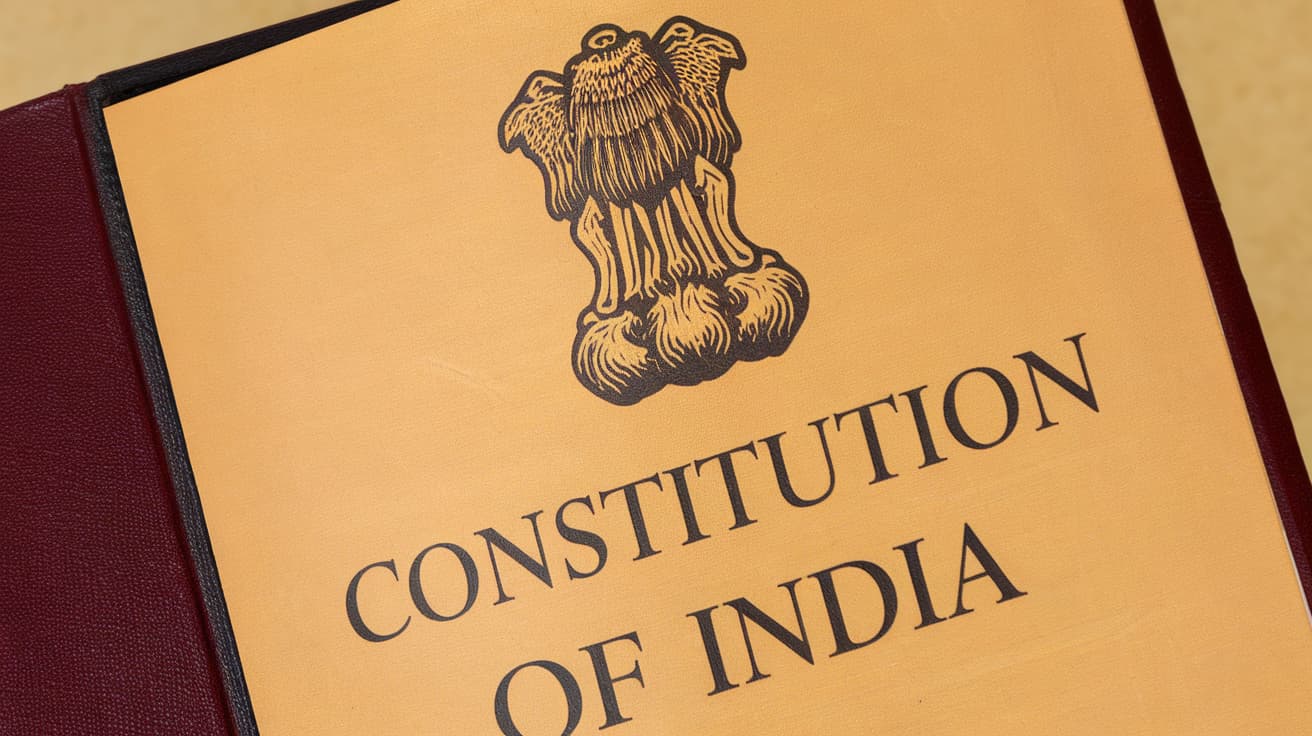
The front page features an intricate design of the national emblem — the Ashoka Lion Capital.
The use of golden borders and motifs reflects India’s cultural richness.
This makes the Constitution a blend of law, art, and heritage.
The original handwritten Constitution is kept in a helium-filled airtight case inside the Parliament Library (New Delhi).
The case is designed to protect the parchment and ink from humidity, light, and temperature changes.
Only authorized officials and researchers can view it under strict security.
It is occasionally displayed on special national occasions like Constitution Day (26 November) and Republic Day (26 January).
Longest Constitution: The Indian Constitution is the longest written constitution in the world.
Time Taken to Draft: It took 2 years, 11 months, and 18 days to complete.
Cost of Drafting: ₹6.4 million (₹64 lakh at that time).
Drafting Committee Chairman: Dr. B. R. Ambedkar.
Signatures: The Constitution was signed by 284 members of the Constituent Assembly.
Adopted Before Republic Day: Adopted on 26 November 1949 but implemented on 26 January 1950.
Calligraphy: Entirely handwritten — no printing or typing was used.
Weight: The original handwritten document weighs around 3.75 kg.
To sum up:
The original handwritten Constitution of India has 251 pages, written on parchment sheets in English.
The current printed version, including all amendments and schedules, runs into over 1,100 pages.
It remains the longest and most detailed Constitution in the world, reflecting India’s vast diversity and democratic vision.
The Constitution of India is not just a legal document — it’s a symbol of freedom, equality, and unity, guiding the nation since 1950.
The original handwritten Constitution has 251 pages, while the current updated version has around 1,100–1,200 pages, depending on the edition.
It was handwritten by Prem Behari Narain Raizada, a skilled calligrapher, in beautiful English script.
The original Constitution is preserved in a helium-filled glass case inside the Parliament Library, New Delhi.
As of 2025, the Constitution has 470+ articles divided into 25 parts.
Because it covers a vast range of subjects — federal structure, fundamental rights, governance at all levels, and special provisions for states and communities — making it both detailed and inclusive.