

How Many National Languages Are There in India?
F
Discover verified facts, data, and insights about India’s states, culture, economy, education, and more — all in one place at FactBharat.
Search for a command to run...
Discover verified facts, data, and insights about India’s states, culture, economy, education, and more — all in one place at FactBharat.
No comments yet. Be the first to comment.
Moving to the USA from India is a dream for many. Whether you want to study, work, or live with family, the process can seem complex. But with the right information, you can plan your move confidently. I’ll guide you through the key steps and options...
Opening a college in India is a dream for many educators and entrepreneurs who want to contribute to the country’s education sector. If you are one of those who want to start a college, you need to understand the process clearly. It involves several ...
Opening a hospital in India is a significant and rewarding venture. If you’ve ever wondered how to start one, you’re in the right place. Whether you’re a healthcare professional, entrepreneur, or investor, understanding the process is crucial. You’ll...
Opening a medical store in India can be a rewarding business opportunity. You get to serve your community by providing essential medicines and healthcare products. If you are thinking about starting a medical store, you might wonder where to begin an...
Opening a restaurant in India can be an exciting and rewarding venture. Whether you dream of serving traditional Indian dishes or international cuisine, the process involves careful planning and understanding of local regulations. If you’re ready to ...
FactBharat | Insights About India
2558 posts
Discover verified facts, data, and insights about India’s states, culture, economy, education, and more — all in one place at FactBharat.
India is known for its incredible linguistic diversity — hundreds of languages are spoken across its states and union territories. From Hindi in the north to Tamil and Malayalam in the south, and from Bengali in the east to Gujarati in the west, every region has its unique linguistic identity.
But one question often creates confusion: “How many national languages are there in India?”
The simple answer is — India does not have any national language.
Let’s understand why that is, and what the official languages of India are according to the Constitution.
Contrary to popular belief, India has no national language.
The Constitution of India does not declare any language as the national language.
This decision was made to respect India’s linguistic and cultural diversity. Instead of promoting one language above others, India chose to have official languages for government communication.
So, while people often refer to Hindi as the “national language,” that is not legally correct — Hindi is one of the official languages, but not the national language of India.
According to Article 343 of the Indian Constitution, the official language of the Union (Central Government) is:
Hindi (in the Devanagari script)
English (for official and administrative purposes)
So, India has two official languages at the national level — Hindi and English.
Hindi is used for communication within most government departments and among Hindi-speaking states.
English is used for communication between the central government and non-Hindi-speaking states, as well as for judiciary, legislation, and international affairs.
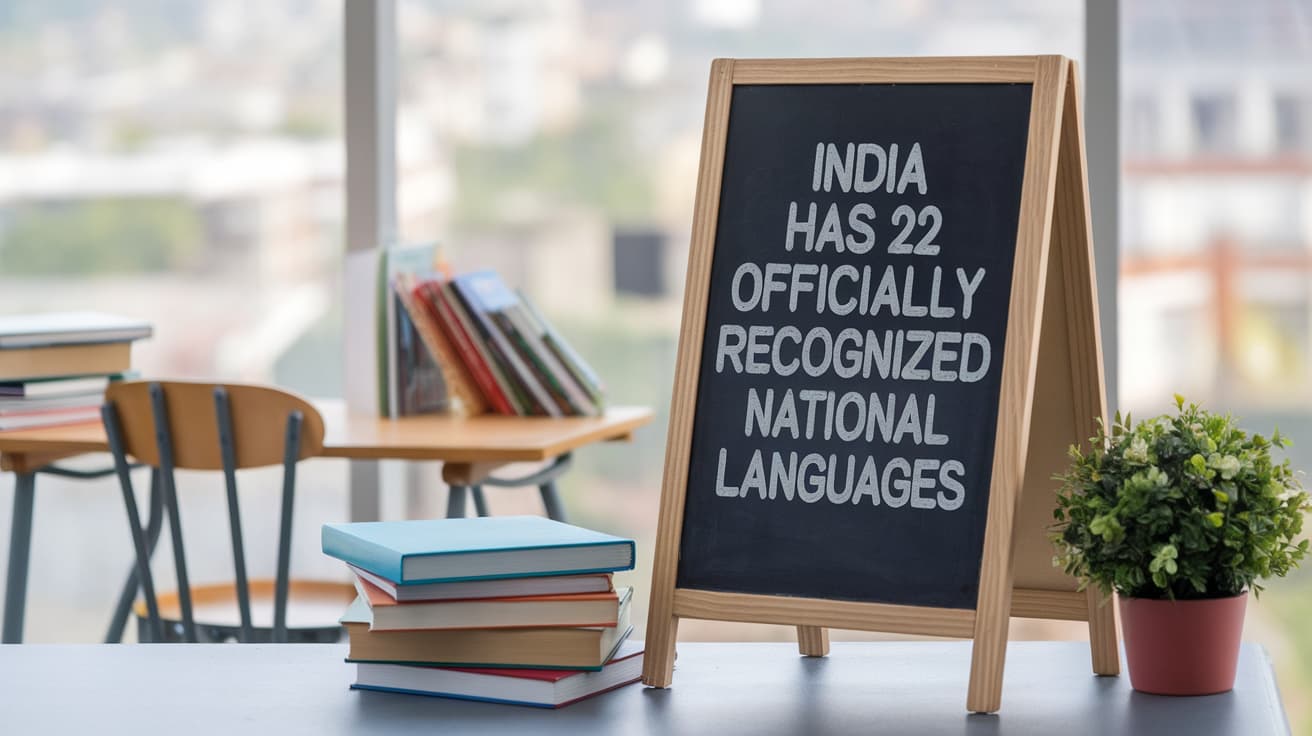
While there’s no national language, India officially recognizes 22 languages under the Eighth Schedule of the Constitution.
These are sometimes referred to as scheduled languages and represent India’s rich linguistic heritage.
Assamese
Bengali
Bodo
Dogri
Gujarati
Hindi
Kannada
Kashmiri
Konkani
Maithili
Malayalam
Manipuri
Marathi
Nepali
Odia
Punjabi
Sanskrit
Santali
Sindhi
Tamil
Telugu
Urdu
These languages are recognized for use in government, education, literature, and official communication at the state and regional levels.
When the Constitution was being drafted after independence, there was a major debate about choosing a national language.
Some leaders wanted Hindi to be the national language, while others from southern and northeastern states opposed the idea, as Hindi was not widely spoken there.
To maintain unity in a multilingual nation, the Constituent Assembly decided:
India would not have any national language.
Hindi and English would serve as official languages for administrative purposes.
This decision ensured that no linguistic group felt excluded or discriminated against, helping preserve India’s unity in diversity.
| Aspect | National Language | Official Language |
| Meaning | Represents the cultural identity of a nation. | Used for government, legal, and administrative purposes. |
| Status in India | India has no national language. | India has two official languages — Hindi and English. |
| Purpose | Symbolic of national pride or heritage. | Practical use for governance and communication. |
| Example | Japan – Japanese; France – French | India – Hindi & English (official) |
India’s states and union territories have the freedom to adopt their own official languages for local governance.
Tamil Nadu: Tamil
Maharashtra: Marathi
West Bengal: Bengali
Kerala: Malayalam
Gujarat: Gujarati
Karnataka: Kannada
Punjab: Punjabi
Many states also use English or Hindi for inter-state and central communication.
This flexible system allows each state to promote its regional language while maintaining smooth communication with the Union government.
English continues to play a vital role in India’s administration, education, and global communication.
It serves as a link language between Hindi-speaking and non-Hindi-speaking states.
It is used in higher education, business, law, and international diplomacy.
The Indian Constitution allows the continued use of English for official purposes as long as needed.
This balance between Hindi and English has helped India function efficiently as a multilingual democracy.
Hindi is the most spoken language in India, followed by Bengali, Marathi, and Telugu.
India ranks second in the world (after Papua New Guinea) for linguistic diversity.
The Census of India lists over 19,500 languages and dialects spoken across the country.
Sanskrit, one of the oldest languages in the world, is still used in religious and academic contexts.
Tamil is the oldest surviving classical language still spoken today.
These facts highlight how language forms the backbone of India’s cultural identity.
To promote unity and linguistic balance, India follows the Three-Language Formula in education:
Mother tongue or regional language
Hindi (or another Indian language)
English
This system helps students connect with their culture while gaining access to national and international communication.
To sum up, India does not have any national language. Instead, it has two official languages — Hindi and English — used for government and administrative purposes. Additionally, 22 languages are recognized in the Constitution under the Eighth Schedule.
This multilingual framework reflects India’s philosophy of “Unity in Diversity” — embracing different languages, cultures, and traditions while functioning as one nation.
India has no national language. The Constitution does not declare any language as the national language.
The official languages of India are Hindi (in Devanagari script) and English.
The Eighth Schedule of the Constitution recognizes 22 scheduled languages.
No. Hindi is not the national language — it is one of the official languages used by the Government of India.
Tamil is considered the oldest living language in India and one of the oldest in the world, still spoken today by millions.