

How to Calculate Import Duty in India
F
Discover verified facts, data, and insights about India’s states, culture, economy, education, and more — all in one place at FactBharat.
Search for a command to run...
Discover verified facts, data, and insights about India’s states, culture, economy, education, and more — all in one place at FactBharat.
No comments yet. Be the first to comment.
Moving to the USA from India is a dream for many. Whether you want to study, work, or live with family, the process can seem complex. But with the right information, you can plan your move confidently. I’ll guide you through the key steps and options...
Opening a college in India is a dream for many educators and entrepreneurs who want to contribute to the country’s education sector. If you are one of those who want to start a college, you need to understand the process clearly. It involves several ...
Opening a hospital in India is a significant and rewarding venture. If you’ve ever wondered how to start one, you’re in the right place. Whether you’re a healthcare professional, entrepreneur, or investor, understanding the process is crucial. You’ll...
Opening a medical store in India can be a rewarding business opportunity. You get to serve your community by providing essential medicines and healthcare products. If you are thinking about starting a medical store, you might wonder where to begin an...
Opening a restaurant in India can be an exciting and rewarding venture. Whether you dream of serving traditional Indian dishes or international cuisine, the process involves careful planning and understanding of local regulations. If you’re ready to ...
FactBharat | Insights About India
2558 posts
Discover verified facts, data, and insights about India’s states, culture, economy, education, and more — all in one place at FactBharat.
Importing goods into India can be a great way to access products not available locally or to expand your business. But before you start, you need to understand how to calculate import duty in India. This is crucial because import duty affects the total cost of your goods and helps you avoid surprises at customs.
In this article, I’ll walk you through the basics of import duty, the different types of duties you might encounter, and how to calculate them step-by-step. Whether you’re a first-time importer or a seasoned trader, this guide will help you understand the process clearly and confidently.
Import duty is a tax imposed by the Indian government on goods brought into the country from abroad. It is a way to regulate trade, protect local industries, and generate revenue. When you import goods, customs officials calculate the duty based on the type and value of the goods.
There are several types of import duties in India, including:
Each of these duties adds to the total cost you pay when importing.
To calculate import duty, you first need to know the Customs Value of your goods. This is the value on which the duty is charged. The Indian Customs Department uses the transaction value method, which means the price you actually paid for the goods, including:
If the transaction value is not available or reliable, customs may use other methods like the value of identical goods or computed value.
Suppose you import electronic gadgets worth $10,000. The shipping cost is $500, and insurance is $100. The customs value will be:
$10,000 (goods) + $500 (freight) + $100 (insurance) = $10,600
This $10,600 is the base for calculating import duty.
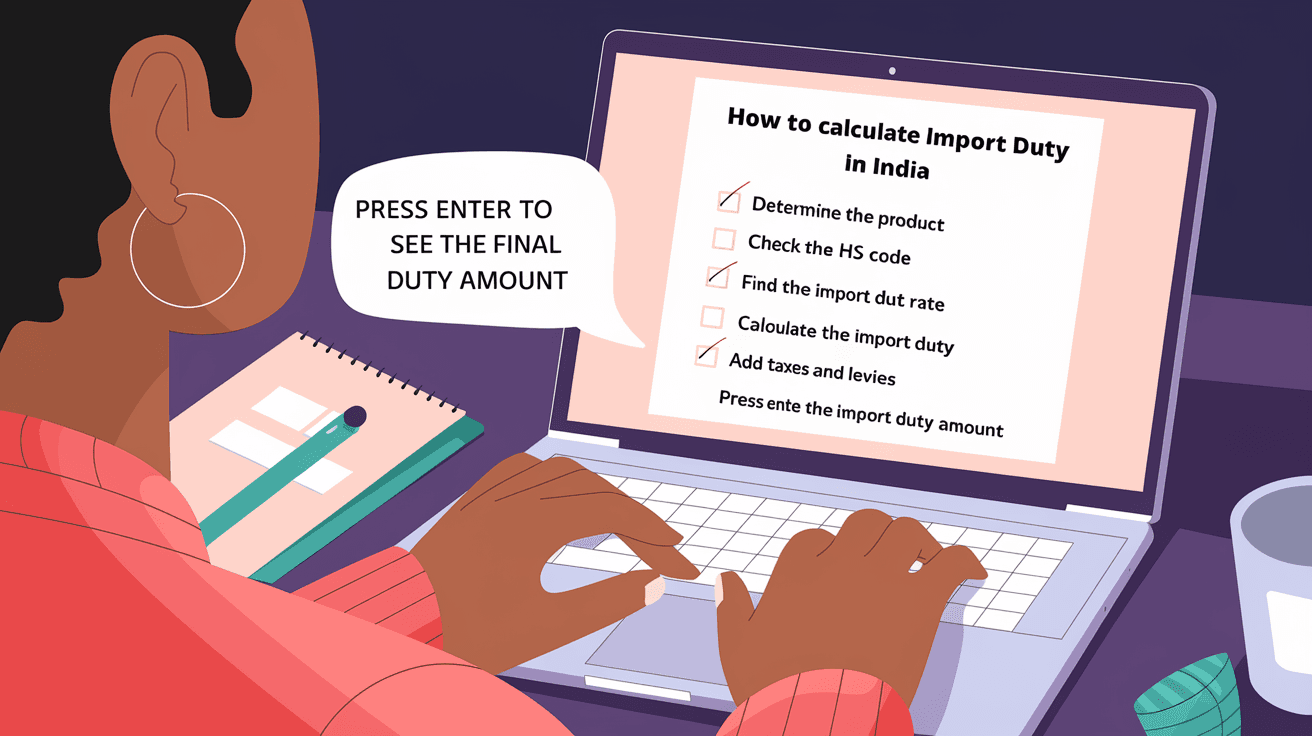
Calculating import duty involves applying the correct duty rates to the customs value. Here’s how you can do it:
Every product has a Harmonized System (HS) Code that classifies it for customs purposes. This code determines the duty rate applicable. You can find the HS code on the Indian Customs website or consult a customs broker.
Once you have the HS code, check the Basic Customs Duty (BCD) rate for that product. The rates vary widely depending on the product category. For example:
Multiply the customs value by the BCD rate.
Basic Customs Duty = Customs Value × BCD Rate
This surcharge is 10% of the Basic Customs Duty.
Social Welfare Surcharge = Basic Customs Duty × 10%
IGST is charged on the sum of customs value, basic customs duty, and social welfare surcharge. The IGST rate depends on the product and ranges from 0% to 28%.
IGST = (Customs Value + Basic Customs Duty + Social Welfare Surcharge) × IGST Rate
Add the Basic Customs Duty, Social Welfare Surcharge, and IGST to get the total import duty payable.
Let’s say you import goods with a customs value of ₹1,00,000. The BCD rate is 10%, and IGST is 18%.
Total Import Duty = ₹10,000 + ₹1,000 + ₹20,520 = ₹31,520
Several factors can influence the final import duty you pay:
Always check the latest customs notifications and consult with a customs broker if unsure.
To make your calculations easier, you can use online tools and resources:
Using these tools helps you avoid errors and estimate costs accurately.
Managing import duty effectively can save you money and time. Here are some tips:
Calculating import duty in India might seem complicated at first, but once you understand the steps, it becomes manageable. You need to know your goods’ HS code, customs value, and the applicable duty rates. Then, apply the basic customs duty, social welfare surcharge, and IGST to get the total duty payable.
By following this guide, you can estimate your import costs accurately and avoid surprises during customs clearance. Remember to use online tools, consult experts when needed, and stay updated on customs regulations. This way, you’ll be better prepared to import goods into India smoothly and cost-effectively.
You can find the HS code on the Indian Customs website or use online HS code lookup tools. Alternatively, consult a customs broker who can classify your goods correctly.
Basic Customs Duty is the initial tax on imported goods, while IGST is a tax similar to GST applied on imports, calculated on the customs value plus the basic duty and surcharge.
Yes, certain goods may be exempt or attract concessional rates under Free Trade Agreements or specific government notifications. Always check the latest customs tariff updates.
Yes, the Indian government updates import duty rates regularly through customs notifications. It’s important to stay informed to avoid unexpected costs.
Key documents include the commercial invoice, bill of lading or airway bill, packing list, insurance certificate, and import license if applicable. Proper documentation ensures smooth clearance.