

How to Become a Veterinarian in India
F
Discover verified facts, data, and insights about India’s states, culture, economy, education, and more — all in one place at FactBharat.
Search for a command to run...
Discover verified facts, data, and insights about India’s states, culture, economy, education, and more — all in one place at FactBharat.
No comments yet. Be the first to comment.
Moving to the USA from India is a dream for many. Whether you want to study, work, or live with family, the process can seem complex. But with the right information, you can plan your move confidently. I’ll guide you through the key steps and options...
Opening a college in India is a dream for many educators and entrepreneurs who want to contribute to the country’s education sector. If you are one of those who want to start a college, you need to understand the process clearly. It involves several ...
Opening a hospital in India is a significant and rewarding venture. If you’ve ever wondered how to start one, you’re in the right place. Whether you’re a healthcare professional, entrepreneur, or investor, understanding the process is crucial. You’ll...
Opening a medical store in India can be a rewarding business opportunity. You get to serve your community by providing essential medicines and healthcare products. If you are thinking about starting a medical store, you might wonder where to begin an...
Opening a restaurant in India can be an exciting and rewarding venture. Whether you dream of serving traditional Indian dishes or international cuisine, the process involves careful planning and understanding of local regulations. If you’re ready to ...
FactBharat | Insights About India
2558 posts
Discover verified facts, data, and insights about India’s states, culture, economy, education, and more — all in one place at FactBharat.
Becoming a veterinarian in India is a rewarding journey if you love animals and want to care for their health. You might wonder how to start and what steps you need to follow. This guide will walk you through the entire process, from education to career options, so you can plan your path clearly.
You will learn about the courses to take, entrance exams to clear, and the skills needed to succeed. Whether you want to work in clinics, research, or animal welfare, this article will help you understand what it takes to become a veterinarian in India.
A veterinarian is a medical professional who treats animals, from pets to livestock. They diagnose illnesses, perform surgeries, and advise on animal care. In India, veterinarians play a vital role in public health, agriculture, and wildlife conservation.
Here are some key responsibilities of veterinarians:
Being a veterinarian requires compassion, patience, and strong scientific knowledge. You will work with different animals and sometimes in challenging environments.
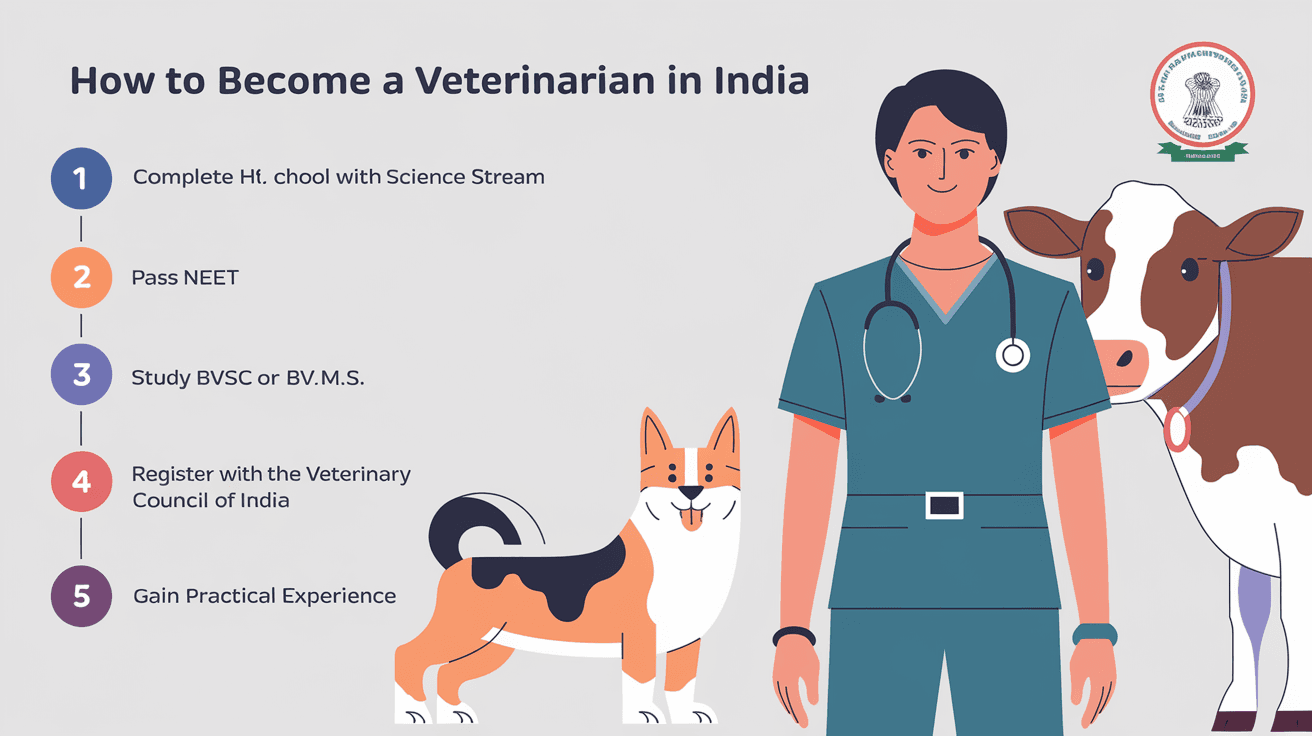
To become a veterinarian, you must complete specific educational qualifications. The main degree required is the Bachelor of Veterinary Science and Animal Husbandry (B.V.Sc & A.H).
Complete 10+2 Education
You need to pass your 12th grade with Physics, Chemistry, Biology, and English. A minimum of 50% marks is usually required.
Clear Entrance Exams
Admission to veterinary colleges is based on entrance exams. The most common exam is the Indian Council of Agricultural Research (ICAR) AIEEA UG. Some states also conduct their own exams.
Enroll in a Recognized Veterinary College
Choose a college approved by the Veterinary Council of India (VCI). The course duration is typically 5.5 years, including a one-year internship.
Complete the B.V.Sc & A.H Degree
The curriculum covers anatomy, physiology, microbiology, pathology, pharmacology, surgery, and animal nutrition.
Register with the Veterinary Council of India
After graduation, you must register with the VCI or the respective State Veterinary Council to practice legally.
Preparing well for these exams is crucial. Focus on biology and chemistry, and practice previous years' question papers.
Being a good veterinarian is not just about academic knowledge. You need several personal and professional skills:
Developing these skills will help you build trust with clients and improve your practice.
Once you complete your degree and registration, many career paths open up. Here are some options you can consider:
After your B.V.Sc & A.H, you can specialize to enhance your skills and career prospects. Some popular postgraduate options include:
Specialization helps you become an expert and may lead to better job opportunities and higher salaries.
Like any profession, veterinary medicine has its challenges. You might face:
However, the rewards are significant:
If you love animals and are ready to work hard, becoming a veterinarian in India can be very fulfilling.
If you are serious about becoming a veterinarian, here are some practical tips:
These steps will help you build a strong foundation for your veterinary career.
Becoming a veterinarian in India requires dedication, education, and passion for animals. You start by completing your 12th grade with science subjects, clearing entrance exams, and earning a B.V.Sc & A.H degree from a recognized college. Registration with the Veterinary Council of India is essential to practice legally.
Once qualified, you have many career options, from clinical practice to research and government jobs. Developing both technical skills and personal qualities will help you succeed. While the journey has challenges, the rewards of caring for animals and contributing to society make it worthwhile. If you love animals and want a meaningful career, becoming a veterinarian in India is a great choice.
You need to complete 10+2 with Physics, Chemistry, Biology, and English, then earn a Bachelor of Veterinary Science and Animal Husbandry (B.V.Sc & A.H) degree.
The main exam is the ICAR AIEEA UG, but some states conduct their own veterinary entrance exams as well.
The B.V.Sc & A.H course typically takes 5.5 years, including a one-year internship.
Yes, you can pursue M.V.Sc, Ph.D., or diploma courses in various veterinary specialties.
Yes, registration with the VCI or State Veterinary Council is required to legally practice as a veterinarian in India.