

How Much Percentage of Land is Plain in India
F
Discover verified facts, data, and insights about India’s states, culture, economy, education, and more — all in one place at FactBharat.
Search for a command to run...
Discover verified facts, data, and insights about India’s states, culture, economy, education, and more — all in one place at FactBharat.
No comments yet. Be the first to comment.
Moving to the USA from India is a dream for many. Whether you want to study, work, or live with family, the process can seem complex. But with the right information, you can plan your move confidently. I’ll guide you through the key steps and options...
Opening a college in India is a dream for many educators and entrepreneurs who want to contribute to the country’s education sector. If you are one of those who want to start a college, you need to understand the process clearly. It involves several ...
Opening a hospital in India is a significant and rewarding venture. If you’ve ever wondered how to start one, you’re in the right place. Whether you’re a healthcare professional, entrepreneur, or investor, understanding the process is crucial. You’ll...
Opening a medical store in India can be a rewarding business opportunity. You get to serve your community by providing essential medicines and healthcare products. If you are thinking about starting a medical store, you might wonder where to begin an...
Opening a restaurant in India can be an exciting and rewarding venture. Whether you dream of serving traditional Indian dishes or international cuisine, the process involves careful planning and understanding of local regulations. If you’re ready to ...
FactBharat | Insights About India
2558 posts
Discover verified facts, data, and insights about India’s states, culture, economy, education, and more — all in one place at FactBharat.
Plains form a vital part of India's geography, shaping its agriculture, population distribution, and economy. If you’ve ever wondered how much of India’s land is covered by plains, you’re not alone. Understanding this helps you grasp the country’s natural landscape and its impact on daily life.
In this article, I’ll walk you through the percentage of land that plains occupy in India. We’ll explore what plains are, their types, and why they matter. By the end, you’ll have a clear picture of India’s plains and their role in the country’s development.
Plains are large, flat areas of land with minimal changes in elevation. They often have fertile soil and are ideal for farming. In India, plains are crucial because they support a large part of the population and contribute significantly to agriculture.
Here’s why plains matter:
Understanding plains helps you see how geography shapes life in India.
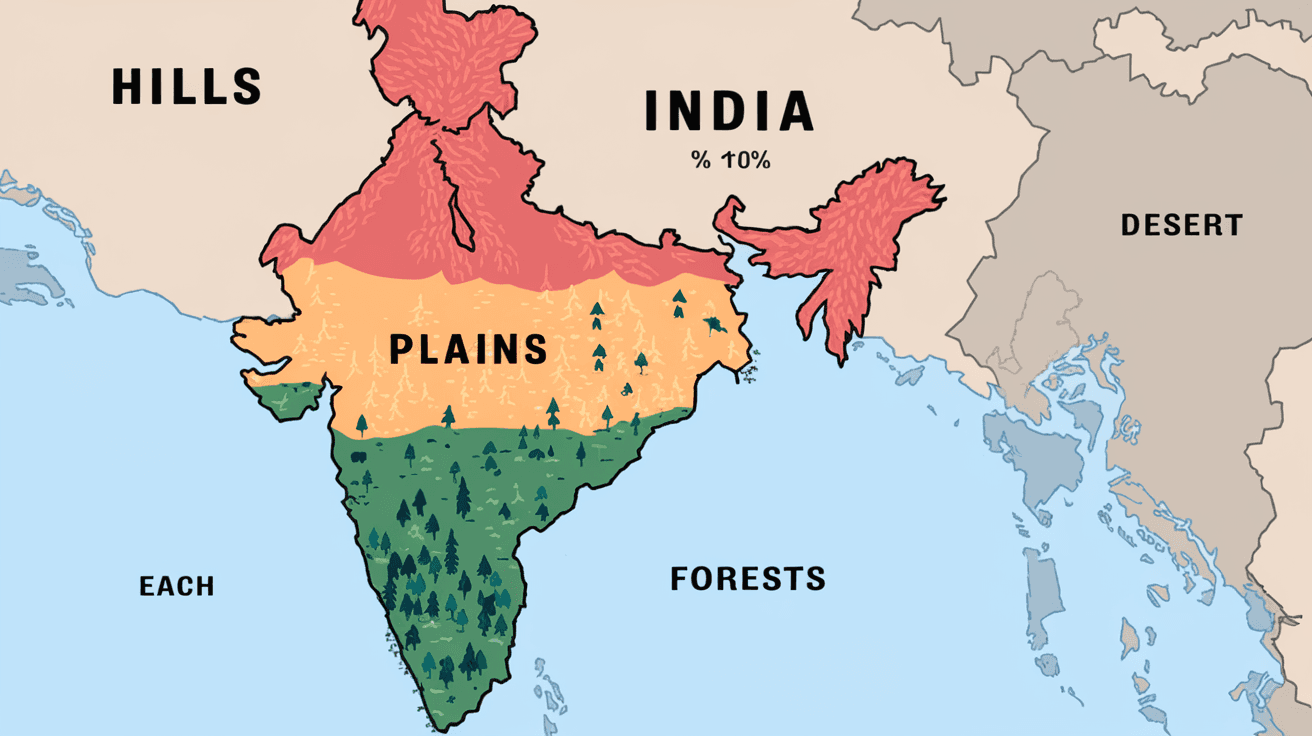
India’s total land area is about 3.287 million square kilometers. Out of this, plains cover roughly 43% to 45% of the land. This means nearly half of India’s land is flat and suitable for farming and settlement.
This percentage includes:
Plains are mostly found in the northern and eastern parts of India, but coastal plains also contribute to this percentage.
India has several types of plains, each formed by different natural processes. Knowing these types helps you understand the diversity of India’s flat lands.
These plains are formed by the deposition of sediments from rivers. The Indo-Gangetic Plain is the most famous example. It stretches across northern India and is one of the world’s largest alluvial plains.
Coastal plains lie along India’s long coastline. They are narrow strips of flat land between the sea and the hills or plateaus.
These plains form along the banks of rivers and are often fertile due to regular flooding.
Plains are not evenly spread across India. Here’s a quick look at where you find the major plains:
| Region | Percentage of Plains | Key Features |
| Indo-Gangetic Plain | ~30% | Largest plain, fertile, populous |
| Coastal Plains | ~10-12% | Narrow strips, fishing, ports |
| Other River Plains | ~3-5% | Smaller plains along rivers |
The Indo-Gangetic Plain dominates the plains landscape, covering parts of Punjab, Haryana, Uttar Pradesh, Bihar, and West Bengal.
Plains are the backbone of Indian agriculture. Since they have fertile soil and good water supply, they support the cultivation of major crops.
Irrigation systems like canals and tube wells are common in plains, helping farmers grow crops year-round.
Plains attract people because they offer easier living conditions compared to mountains or deserts. This leads to high population density in these areas.
This concentration impacts India’s economy and social structure.
Despite their advantages, plains face some challenges:
Addressing these issues is key to maintaining the productivity of plains.
Plains contribute significantly to India’s economy through agriculture, industry, and trade.
The economic health of India is closely tied to the well-being of its plains.
You now know that about 43% to 45% of India’s land is covered by plains. These plains, especially the Indo-Gangetic and coastal plains, play a crucial role in agriculture, population settlement, and the economy. Their fertile soil and flat terrain make them ideal for farming and urban development.
However, plains also face challenges like flooding and urban pressure. Understanding the importance and distribution of plains helps you appreciate how geography influences India’s growth and daily life. Whether you live in a city or a village, plains impact your food, jobs, and environment in many ways.
About 43% to 45% of India’s total land area is covered by plains, including the Indo-Gangetic and coastal plains.
The Indo-Gangetic Plain is the largest and most fertile plain in India, stretching across northern states.
Plains have fertile soil and good water supply, making them ideal for growing major crops like wheat, rice, and sugarcane.
No, plains are mostly concentrated in northern and eastern India, with coastal plains along the east and west coasts.
Plains face flooding, soil erosion, urbanization, and water scarcity, which affect their productivity and sustainability.