

How Many Years of British Rule in India
F
Discover verified facts, data, and insights about India’s states, culture, economy, education, and more — all in one place at FactBharat.
Search for a command to run...
Discover verified facts, data, and insights about India’s states, culture, economy, education, and more — all in one place at FactBharat.
No comments yet. Be the first to comment.
Moving to the USA from India is a dream for many. Whether you want to study, work, or live with family, the process can seem complex. But with the right information, you can plan your move confidently. I’ll guide you through the key steps and options...
Opening a college in India is a dream for many educators and entrepreneurs who want to contribute to the country’s education sector. If you are one of those who want to start a college, you need to understand the process clearly. It involves several ...
Opening a hospital in India is a significant and rewarding venture. If you’ve ever wondered how to start one, you’re in the right place. Whether you’re a healthcare professional, entrepreneur, or investor, understanding the process is crucial. You’ll...
Opening a medical store in India can be a rewarding business opportunity. You get to serve your community by providing essential medicines and healthcare products. If you are thinking about starting a medical store, you might wonder where to begin an...
Opening a restaurant in India can be an exciting and rewarding venture. Whether you dream of serving traditional Indian dishes or international cuisine, the process involves careful planning and understanding of local regulations. If you’re ready to ...
FactBharat | Insights About India
2558 posts
Discover verified facts, data, and insights about India’s states, culture, economy, education, and more — all in one place at FactBharat.
You might wonder how long British rule lasted in India and what it meant for the country. Understanding the timeline helps us see how India changed during this period. It also shows the roots of many modern developments and challenges.
In this article, I’ll take you through the exact years of British control in India. We’ll explore key events, how the rule started, and when it ended. This will give you a clear picture of one of the most important chapters in Indian history.
British involvement in India started much earlier than full control. The British East India Company arrived in the early 1600s, mainly for trade. But the company slowly gained power over Indian territories.
The real start of British political control is often marked by the Battle of Plassey in 1757. This battle gave the company control over Bengal, a rich and powerful region.
So, while British presence began in the 1600s, actual rule started in the mid-18th century.
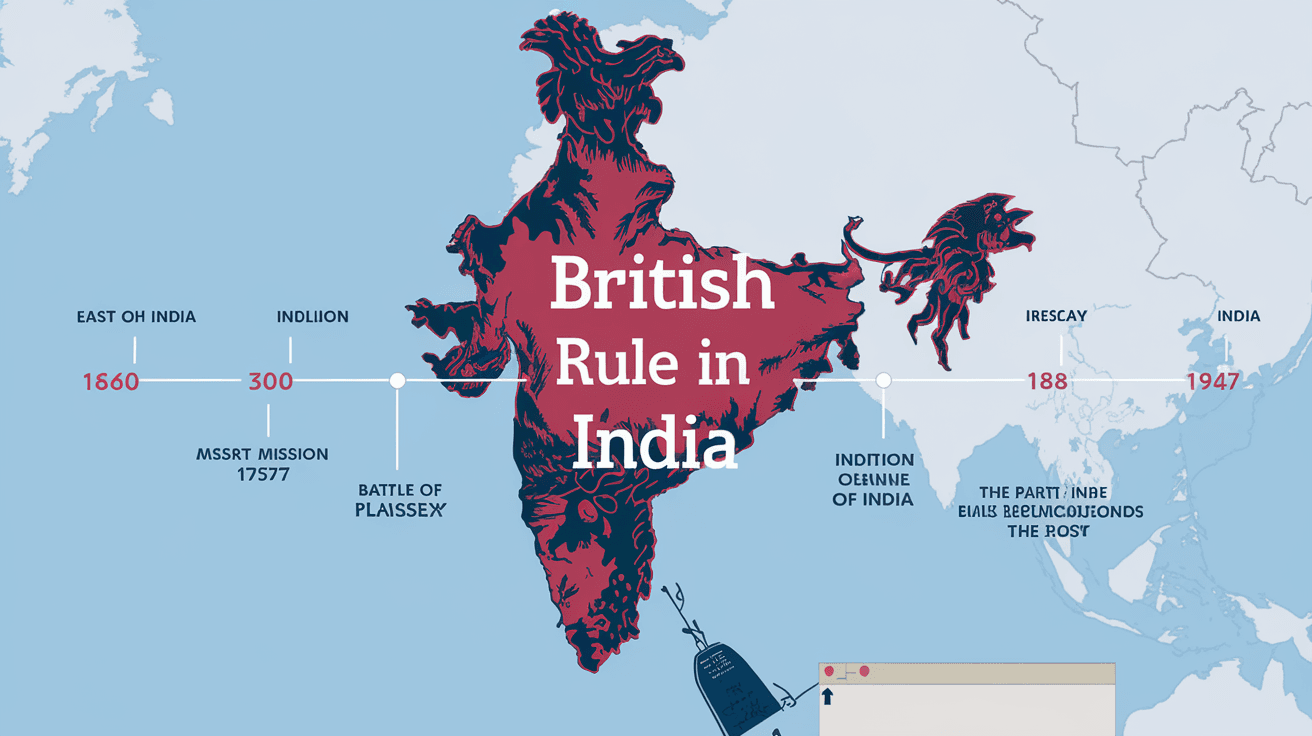
The period of British rule in India is generally counted from 1757 to 1947. This means the British controlled India for about 190 years.
During this time, the company acted as both a business and a government. It collected taxes, maintained armies, and made laws.
After the rebellion, the British government took over. This period is called the British Raj.
The British Raj ended in 1947 when India gained independence.
British rule in India was full of important events that shaped the country’s future. Here are some major milestones:
British rule changed India in many ways. Some changes were positive, while others caused problems.
The end of British rule came after decades of struggle by Indians. The independence movement grew stronger in the 20th century.
| Period | Event/Description | Years |
| Arrival of East India Company | Trading posts established | Early 1600s |
| Battle of Plassey | Start of political control | 1757 |
| East India Company Rule | Company governs large parts of India | 1757–1858 |
| Indian Rebellion | Major uprising against company | 1857 |
| British Raj | Direct British Crown rule | 1858–1947 |
| Indian Independence | End of British rule | 1947 |
Now you know that British rule in India lasted about 190 years, from 1757 to 1947. It began with the East India Company’s rise and ended with India’s independence. This period shaped modern India in many ways, both good and bad.
Understanding this timeline helps you appreciate the struggles and achievements of India’s people. It also explains how historical events still influence India today. If you want to learn more, exploring the independence movement and post-colonial India is a great next step.
The British East India Company ruled parts of India for about 101 years, from 1757 after the Battle of Plassey until 1858 when the British Crown took over.
The British Raj was the period of direct British Crown rule in India, lasting from 1858 to 1947, after the Indian Rebellion of 1857.
India gained independence on August 15, 1947, ending nearly 190 years of British rule.
The end was caused by a strong independence movement, World War II weakening Britain, and political negotiations leading to partition and independence.
Yes, British rule introduced railways, modern education, legal systems, and administration, but it also caused economic and social challenges.