

How Many Train Accidents Per Year in India
F
Discover verified facts, data, and insights about India’s states, culture, economy, education, and more — all in one place at FactBharat.
Search for a command to run...
Discover verified facts, data, and insights about India’s states, culture, economy, education, and more — all in one place at FactBharat.
No comments yet. Be the first to comment.
Moving to the USA from India is a dream for many. Whether you want to study, work, or live with family, the process can seem complex. But with the right information, you can plan your move confidently. I’ll guide you through the key steps and options...
Opening a college in India is a dream for many educators and entrepreneurs who want to contribute to the country’s education sector. If you are one of those who want to start a college, you need to understand the process clearly. It involves several ...
Opening a hospital in India is a significant and rewarding venture. If you’ve ever wondered how to start one, you’re in the right place. Whether you’re a healthcare professional, entrepreneur, or investor, understanding the process is crucial. You’ll...
Opening a medical store in India can be a rewarding business opportunity. You get to serve your community by providing essential medicines and healthcare products. If you are thinking about starting a medical store, you might wonder where to begin an...
Opening a restaurant in India can be an exciting and rewarding venture. Whether you dream of serving traditional Indian dishes or international cuisine, the process involves careful planning and understanding of local regulations. If you’re ready to ...
FactBharat | Insights About India
2558 posts
Discover verified facts, data, and insights about India’s states, culture, economy, education, and more — all in one place at FactBharat.
Train travel is one of the most popular and affordable ways to get around India. Every day, millions of people rely on trains to commute, travel long distances, and transport goods. But with such a vast railway network, safety becomes a critical concern. You might wonder, how many train accidents happen in India each year? Understanding this can help us appreciate the challenges and efforts involved in making train travel safer.
In this article, I’ll walk you through the current statistics on train accidents in India, the main causes behind them, and what steps are being taken to reduce these incidents. Whether you’re a regular traveler or just curious, this information will give you a clear picture of railway safety in India today.
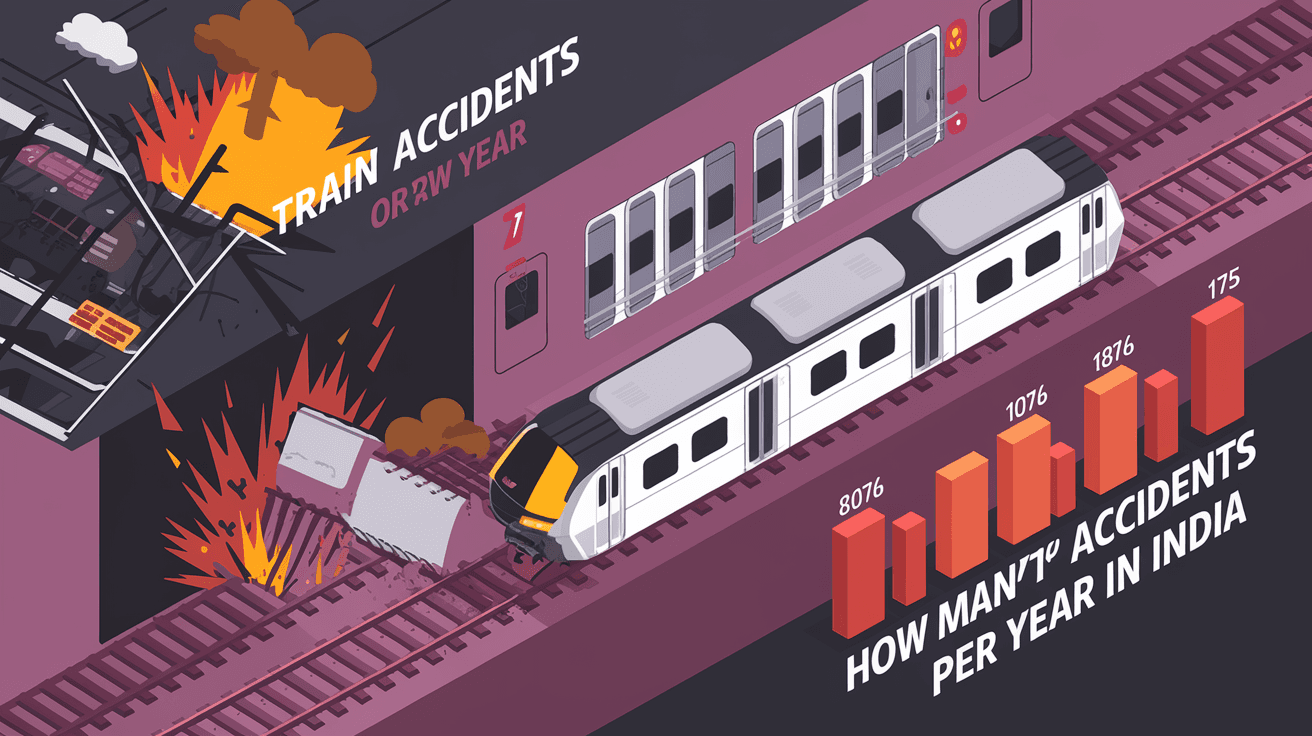
India has one of the largest railway networks in the world, covering over 68,000 kilometers and serving more than 23 million passengers daily. With such a massive system, accidents unfortunately do occur. On average, India experiences around 1,000 to 1,200 train accidents annually. These accidents include collisions, derailments, and level crossing mishaps.
These numbers may seem high, but it’s important to note that the Indian Railways has been working hard to improve safety. Over the past decade, the number of accidents has gradually decreased due to better technology and stricter safety protocols.
Understanding why train accidents happen is key to preventing them. The causes can be broadly divided into human error, technical failures, and infrastructure issues.
Human mistakes are responsible for a significant portion of train accidents. These include:
Mechanical and technical problems also contribute to accidents:
India’s railway infrastructure faces challenges such as:
Train accidents in India can be categorized into several types, each with different causes and consequences.
Collisions happen when two trains crash into each other or when a train hits a vehicle or obstacle on the track. These are often due to signaling errors or human mistakes.
Derailments occur when a train leaves the tracks. Causes include track defects, excessive speed, or mechanical failures. Derailments can be very dangerous, especially for passenger trains.
Level crossing accidents happen when vehicles or pedestrians cross railway tracks unsafely. Many crossings in India are unmanned, increasing the risk of accidents.
Occasionally, fires or other incidents like sabotage or natural calamities cause accidents. These are less common but can be severe.
The Indian Railways has made significant progress in reducing accidents over the years. Here are some recent trends and safety measures:
The Indian government and Indian Railways have launched several initiatives to improve safety:
While the railways work on improving safety, you can also take steps to protect yourself:
Looking ahead, India is focusing on technology and infrastructure to make train travel safer:
These advancements promise a safer railway system for millions of passengers.
Train accidents in India have been a serious concern due to the vastness of the railway network and the volume of passengers. On average, around 1,000 to 1,200 accidents occur each year, with human error, technical failures, and infrastructure challenges as the main causes. However, the good news is that the number of accidents is steadily declining thanks to government initiatives, technological upgrades, and increased public awareness.
As a traveler, staying informed and cautious can help you stay safe. Meanwhile, ongoing improvements in railway safety systems and infrastructure are making train journeys safer and more reliable. With continued efforts, India’s railways are moving towards a future with fewer accidents and safer travel for everyone.
India experiences about 1,000 to 1,200 train accidents each year, including collisions, derailments, and level crossing mishaps.
Human error, such as signal passing mistakes and negligence at level crossings, is the leading cause of train accidents.
Yes, unmanned level crossings significantly increase the risk of accidents and are a focus area for safety improvements.
Indian Railways uses systems like Kavach (automatic train protection), modern signaling, and sensors at level crossings to enhance safety.
Yes, the number of train accidents has decreased by nearly 30% over the past five years due to better safety measures and infrastructure upgrades.