

How Many States Were There in India in 1950
F
Discover verified facts, data, and insights about India’s states, culture, economy, education, and more — all in one place at FactBharat.
Search for a command to run...
Discover verified facts, data, and insights about India’s states, culture, economy, education, and more — all in one place at FactBharat.
No comments yet. Be the first to comment.
Moving to the USA from India is a dream for many. Whether you want to study, work, or live with family, the process can seem complex. But with the right information, you can plan your move confidently. I’ll guide you through the key steps and options...
Opening a college in India is a dream for many educators and entrepreneurs who want to contribute to the country’s education sector. If you are one of those who want to start a college, you need to understand the process clearly. It involves several ...
Opening a hospital in India is a significant and rewarding venture. If you’ve ever wondered how to start one, you’re in the right place. Whether you’re a healthcare professional, entrepreneur, or investor, understanding the process is crucial. You’ll...
Opening a medical store in India can be a rewarding business opportunity. You get to serve your community by providing essential medicines and healthcare products. If you are thinking about starting a medical store, you might wonder where to begin an...
Opening a restaurant in India can be an exciting and rewarding venture. Whether you dream of serving traditional Indian dishes or international cuisine, the process involves careful planning and understanding of local regulations. If you’re ready to ...
FactBharat | Insights About India
2558 posts
Discover verified facts, data, and insights about India’s states, culture, economy, education, and more — all in one place at FactBharat.
India in 1950 was very different from the country we know today. If you’ve ever wondered how many states there were back then, you’re not alone. Understanding India’s political map in 1950 helps you see how the nation evolved over time. It’s a fascinating story of change, unity, and diversity.
In this article, I’ll walk you through the number of states India had in 1950, the types of states, and how the country’s administrative divisions were organized. You’ll also learn about the major changes that shaped India’s states after 1950. Let’s dive into this historical journey together.
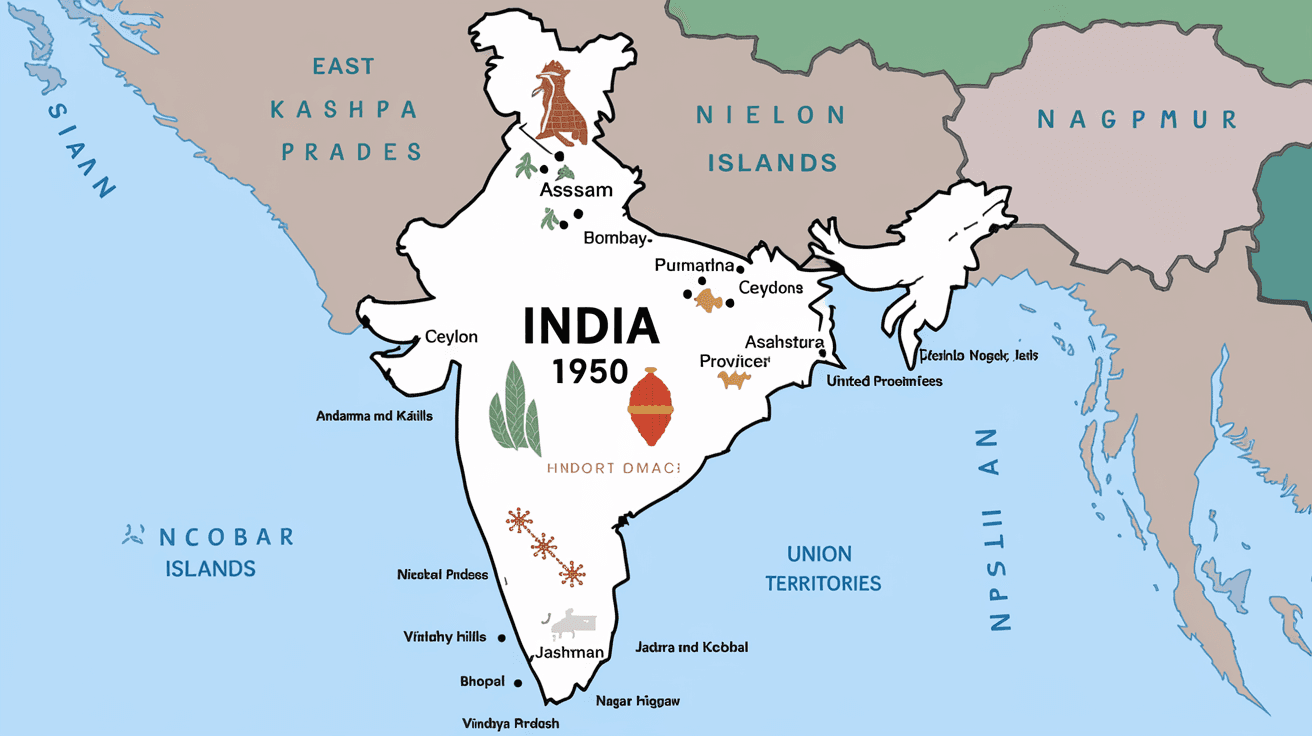
When India became a republic on January 26, 1950, its political map was quite complex. The country was divided into different types of administrative units, not just the states we think of today. There were:
Each type had a different status and governance system. This classification was part of the Constitution of India, which came into effect in 1950.
Part A states were the former British provinces. These were the largest and most important states, governed by a Governor appointed by the President of India. They had elected state legislatures and were similar to today’s states.
Examples of Part A states included:
Part B states were former princely states or groups of princely states that had merged or were integrated into India after independence. These states had a Rajpramukh (a kind of governor) appointed from the former rulers or nominated by the President.
Examples of Part B states were:
Part C states were smaller territories directly governed by the central government through a Chief Commissioner or Lieutenant Governor. They did not have the same autonomy as Part A or B states.
Examples of Part C states included:
There was only one Part D state: the Andaman and Nicobar Islands. It was governed by a Lieutenant Governor appointed by the central government.
Counting all these categories, India had a total of 27 states in 1950. Here’s the breakdown:
| State Category | Number of States | Examples |
| Part A | 10 | Madras, Bombay, Punjab |
| Part B | 8 | Hyderabad, Mysore, Jammu & Kashmir |
| Part C | 9 | Delhi, Himachal Pradesh, Coorg |
| Part D | 1 | Andaman and Nicobar Islands |
This classification was unique to the early years of the Indian Republic. It reflected the country’s transition from British colonial rule and princely states to a unified nation.
The division into Parts A, B, C, and D states was designed to manage the diversity and complexity of India’s regions after independence. Here’s why:
This system allowed India to maintain stability while integrating many different regions and rulers into one country.
The 1950 state structure didn’t last long. By 1956, India passed the States Reorganization Act, which changed the map dramatically. The main goal was to organize states based on linguistic and cultural similarities.
Key changes included:
After 1956, the classification of states into Parts A, B, C, and D was abolished. India moved to a simpler system of states and union territories.
Let’s look at a few states from 1950 and how they changed:
In 1950, India also had union territories, but they were fewer and less defined than today. The concept of union territories evolved after 1956 when some regions were directly governed by the central government without statehood.
Examples of union territories today include:
In 1950, many of these areas were part of Part C or D states.
India’s states have increased over time due to demands for better governance and recognition of cultural identities. Some key milestones:
Today, India has 28 states and 8 union territories, a big change from the 27 states in 1950.
Understanding India’s states in 1950 helps you appreciate the country’s political history. It shows how India managed diversity and unity after independence. It also explains the reasons behind the linguistic reorganization and the ongoing evolution of states.
If you’re interested in Indian history, politics, or geography, this knowledge gives you a clearer picture of how India became the nation it is today.
| Category | Number | Examples | Governance Type |
| Part A | 10 | Madras, Bombay, Punjab | Governor appointed by President |
| Part B | 8 | Hyderabad, Mysore, Rajasthan | Rajpramukh (former rulers) |
| Part C | 9 | Delhi, Himachal Pradesh, Coorg | Chief Commissioner/Lt. Governor |
| Part D | 1 | Andaman and Nicobar Islands | Lt. Governor |
This table sums up the political divisions of India in 1950.
So, how many states were there in India in 1950? The answer is 27, divided into four categories: Part A, B, C, and D states. This system reflected India’s complex history of British provinces and princely states.
Over the years, India’s states have changed a lot, especially after the States Reorganization Act of 1956. Today’s India with 28 states and 8 union territories is the result of decades of political and cultural evolution. Knowing about India’s states in 1950 helps you understand the country’s journey toward unity and diversity.
India had 27 states in 1950, divided into Part A, B, C, and D states based on their administrative status.
Part A states were former British provinces with governors appointed by the President and elected legislatures.
It was a law that reorganized Indian states mainly on linguistic lines, abolishing the Part A, B, C, D classification.
The Andaman and Nicobar Islands were the only Part D state, governed by a Lieutenant Governor.
India currently has 28 states and 8 union territories, reflecting changes since 1950.