

How Many Nuclear Reactors Are There in India
F
Discover verified facts, data, and insights about India’s states, culture, economy, education, and more — all in one place at FactBharat.
Search for a command to run...
Discover verified facts, data, and insights about India’s states, culture, economy, education, and more — all in one place at FactBharat.
No comments yet. Be the first to comment.
Moving to the USA from India is a dream for many. Whether you want to study, work, or live with family, the process can seem complex. But with the right information, you can plan your move confidently. I’ll guide you through the key steps and options...
Opening a college in India is a dream for many educators and entrepreneurs who want to contribute to the country’s education sector. If you are one of those who want to start a college, you need to understand the process clearly. It involves several ...
Opening a hospital in India is a significant and rewarding venture. If you’ve ever wondered how to start one, you’re in the right place. Whether you’re a healthcare professional, entrepreneur, or investor, understanding the process is crucial. You’ll...
Opening a medical store in India can be a rewarding business opportunity. You get to serve your community by providing essential medicines and healthcare products. If you are thinking about starting a medical store, you might wonder where to begin an...
Opening a restaurant in India can be an exciting and rewarding venture. Whether you dream of serving traditional Indian dishes or international cuisine, the process involves careful planning and understanding of local regulations. If you’re ready to ...
FactBharat | Insights About India
2558 posts
Discover verified facts, data, and insights about India’s states, culture, economy, education, and more — all in one place at FactBharat.
India's nuclear energy program has grown steadily over the years, playing a crucial role in the country's energy mix. If you’re curious about how many nuclear reactors India has, you’re not alone. Many people want to understand the scale of India’s nuclear power infrastructure and how it supports the nation’s energy needs.
In this article, I’ll walk you through the current number of nuclear reactors in India, their types, where they are located, and what the future holds for nuclear energy in the country. This will give you a clear picture of India’s nuclear landscape and its role in sustainable energy development.
India currently operates 23 nuclear reactors that are connected to the grid and actively generating electricity. These reactors are spread across several nuclear power plants in different states. The total installed nuclear power capacity in India is about 7,400 megawatts (MW).
Here’s a quick overview of the reactors:
India’s nuclear reactors are a mix of indigenous designs and imported technology, reflecting the country’s focus on self-reliance and strategic partnerships.
Understanding the types of reactors helps you grasp how India manages its nuclear fuel and energy production.
PHWRs are the backbone of India’s nuclear program. They use heavy water (deuterium oxide) as both a coolant and a neutron moderator. This design allows India to use natural uranium as fuel, which is more abundant and less expensive than enriched uranium.
LWRs use ordinary water as a coolant and moderator. India has a few LWRs, including:
India is investing in fast breeder technology to make better use of its nuclear fuel resources.
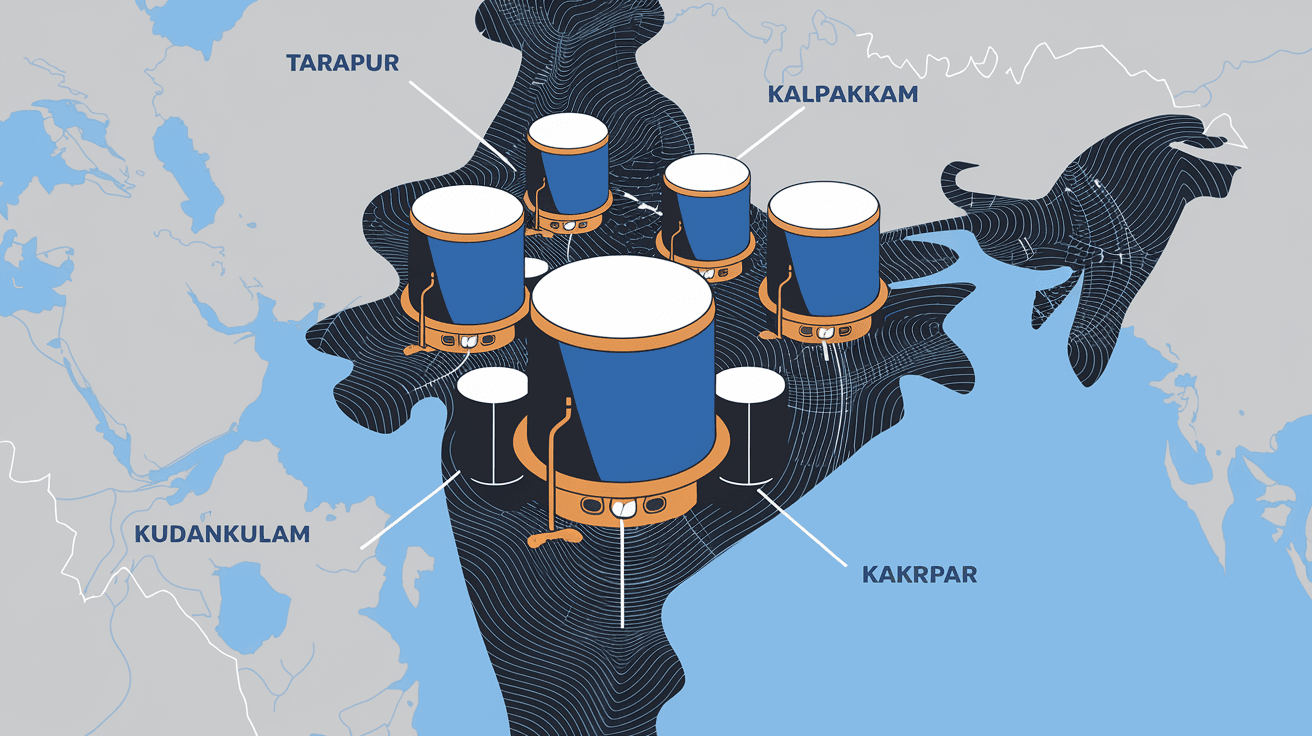
India’s nuclear reactors are strategically located across the country to balance energy supply and safety.
| Location | Number of Reactors | Reactor Type(s) | Notable Plants |
| Tamil Nadu | 7 | PHWR, LWR | Madras, Kudankulam |
| Rajasthan | 6 | PHWR | Rajasthan Nuclear Power Plant |
| Maharashtra | 4 | PHWR | Tarapur Nuclear Power Station |
| Karnataka | 2 | PHWR | Kaiga Nuclear Power Plant |
| Andhra Pradesh | 2 | PHWR | Kakrapar Atomic Power Station |
| Odisha | 1 | PHWR | Narora Atomic Power Station |
| Tamil Nadu (Kalpakkam) | 1 (PFBR) | Fast Breeder Reactor | Prototype Fast Breeder Reactor |
These locations are chosen based on factors like water availability, seismic safety, and proximity to demand centers.
Nuclear power contributes about 3-4% of India’s total electricity generation. While this may seem small, it is a significant part of the country’s clean energy strategy.
India has ambitious plans to expand its nuclear power capacity. Here’s what you should know:
The expansion plans reflect India’s commitment to clean energy and energy security.
Safety is a top priority in India’s nuclear program. The Atomic Energy Regulatory Board (AERB) oversees the safety and regulation of all nuclear facilities.
This focus on safety ensures that nuclear energy remains a reliable and secure power source.
Despite progress, India’s nuclear energy sector faces some challenges:
Addressing these issues is essential for India to realize its nuclear energy goals.
Now you know that India operates 23 nuclear reactors, mainly PHWRs, with a few LWRs and a fast breeder reactor under development. These reactors are spread across several states, contributing about 3-4% of India’s electricity. The country has big plans to expand its nuclear capacity, focusing on indigenous technology and thorium utilization.
India’s nuclear program is a key part of its clean energy future, balancing energy security and environmental concerns. While challenges remain, the steady growth and strong regulatory framework show India’s commitment to safe and sustainable nuclear power.
India has 23 operational nuclear reactors generating electricity across various states.
India primarily uses Pressurized Heavy Water Reactors (PHWRs), Light Water Reactors (LWRs), and is developing Fast Breeder Reactors (FBRs).
They are mainly located in Tamil Nadu, Rajasthan, Maharashtra, Karnataka, Andhra Pradesh, and Odisha.
Nuclear power contributes about 3-4% of India’s total electricity generation.
India plans to increase nuclear capacity to over 22,000 MW by 2031, focusing on indigenous reactors and thorium fuel use.