

How Many Minorities in India
F
Discover verified facts, data, and insights about India’s states, culture, economy, education, and more — all in one place at FactBharat.
Search for a command to run...
Discover verified facts, data, and insights about India’s states, culture, economy, education, and more — all in one place at FactBharat.
No comments yet. Be the first to comment.
Moving to the USA from India is a dream for many. Whether you want to study, work, or live with family, the process can seem complex. But with the right information, you can plan your move confidently. I’ll guide you through the key steps and options...
Opening a college in India is a dream for many educators and entrepreneurs who want to contribute to the country’s education sector. If you are one of those who want to start a college, you need to understand the process clearly. It involves several ...
Opening a hospital in India is a significant and rewarding venture. If you’ve ever wondered how to start one, you’re in the right place. Whether you’re a healthcare professional, entrepreneur, or investor, understanding the process is crucial. You’ll...
Opening a medical store in India can be a rewarding business opportunity. You get to serve your community by providing essential medicines and healthcare products. If you are thinking about starting a medical store, you might wonder where to begin an...
Opening a restaurant in India can be an exciting and rewarding venture. Whether you dream of serving traditional Indian dishes or international cuisine, the process involves careful planning and understanding of local regulations. If you’re ready to ...
FactBharat | Insights About India
2558 posts
Discover verified facts, data, and insights about India’s states, culture, economy, education, and more — all in one place at FactBharat.
India is known for its incredible diversity, with many communities living together in harmony. When you ask, "How many minorities are in India?" you’re diving into a complex and fascinating topic. Minorities in India include religious, linguistic, and ethnic groups that differ from the majority population. Understanding their numbers helps us appreciate the country’s rich cultural fabric.
In this article, I’ll guide you through the main minority groups in India, their population sizes, and their social and cultural roles. Whether you’re curious about religious minorities like Muslims and Christians or linguistic minorities like tribal languages, you’ll find clear and up-to-date information here.
In India, a minority is generally a group that is smaller in number compared to the majority population. This can be based on religion, language, ethnicity, or culture. The government officially recognizes certain groups as minorities to protect their rights and promote equality.
The Ministry of Minority Affairs in India focuses mainly on religious minorities, but linguistic and ethnic minorities also receive attention through various policies.
Religion is one of the most significant markers of minority status in India. The country’s majority religion is Hinduism, practiced by about 80% of the population. The rest belong to various minority religions.
Religious minorities contribute richly to India’s culture, festivals, cuisine, and arts. They also face unique challenges, such as social discrimination and political representation issues. The government has special schemes to support their education and economic development.
India is home to hundreds of languages, many of which are spoken by minority groups. The Constitution recognizes 22 official languages, but there are over 1,600 languages and dialects spoken across the country.
Linguistic minorities preserve cultural heritage and traditional knowledge. India’s government promotes mother tongue education and media in minority languages to keep them alive. Language rights are also linked to social inclusion and political participation.
India’s tribal population is a significant ethnic minority. Known as Scheduled Tribes (ST), they make up about 8.6% of the population, roughly 110 million people.
The Indian government provides constitutional safeguards for Scheduled Tribes, including reserved seats in education and government jobs. Special development programs aim to improve their living standards while respecting their cultural identity.
Counting minorities in India involves census data and surveys. The Census of India collects information on religion, language, and social groups every ten years. The latest census provides detailed data on minority populations.
These statistics help policymakers design targeted welfare programs and protect minority rights.
Despite legal protections, minorities in India face several challenges:
Efforts by NGOs, government schemes, and community leaders aim to address these issues and promote inclusion.
Minorities enrich India’s society in many ways:
Understanding the size and role of minorities helps us appreciate the country’s unity in diversity.
India’s minorities are a vital part of its identity. From religious groups like Muslims and Christians to linguistic and tribal communities, millions of people contribute to the nation’s rich cultural mosaic. Knowing how many minorities live in India helps us recognize their importance and the need to protect their rights.
As you explore India’s diversity, remember that every minority group adds a unique thread to the country’s social fabric. Supporting their growth and inclusion benefits all of us, making India stronger and more vibrant.
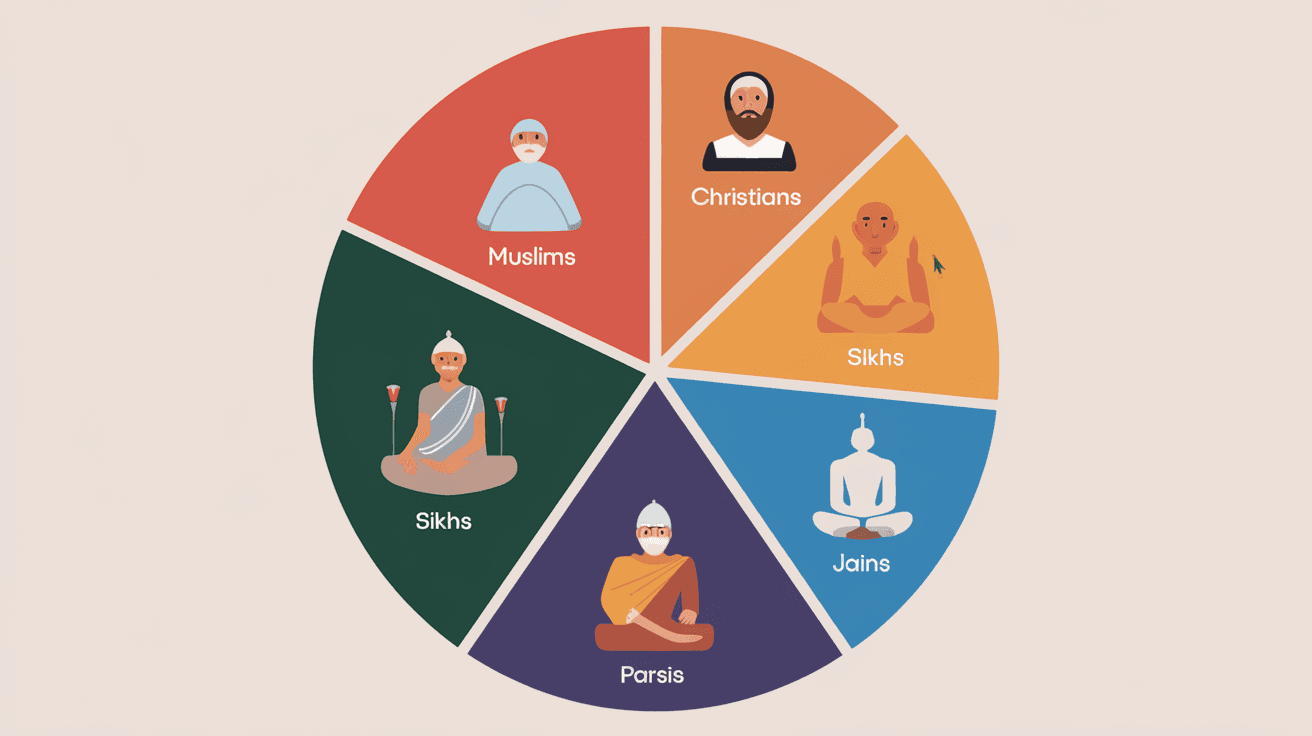
India officially recognizes six religious minorities: Muslims, Christians, Sikhs, Buddhists, Jains, and Parsis. Together, they make up about 20% of the population.
Scheduled Tribes constitute about 8.6% of India’s population, roughly 110 million people, living mainly in forested and remote areas.
Yes, India promotes linguistic minorities through education in mother tongues and media support, preserving their languages and cultures.
Islam is the largest minority religion, with Muslims making up approximately 14.2% of the population.
The government provides reservations in education and jobs, welfare schemes, and legal protections to promote minority rights and development.