

How Many Landlocked States in India
F
Discover verified facts, data, and insights about India’s states, culture, economy, education, and more — all in one place at FactBharat.
Search for a command to run...
Discover verified facts, data, and insights about India’s states, culture, economy, education, and more — all in one place at FactBharat.
No comments yet. Be the first to comment.
Moving to the USA from India is a dream for many. Whether you want to study, work, or live with family, the process can seem complex. But with the right information, you can plan your move confidently. I’ll guide you through the key steps and options...
Opening a college in India is a dream for many educators and entrepreneurs who want to contribute to the country’s education sector. If you are one of those who want to start a college, you need to understand the process clearly. It involves several ...
Opening a hospital in India is a significant and rewarding venture. If you’ve ever wondered how to start one, you’re in the right place. Whether you’re a healthcare professional, entrepreneur, or investor, understanding the process is crucial. You’ll...
Opening a medical store in India can be a rewarding business opportunity. You get to serve your community by providing essential medicines and healthcare products. If you are thinking about starting a medical store, you might wonder where to begin an...
Opening a restaurant in India can be an exciting and rewarding venture. Whether you dream of serving traditional Indian dishes or international cuisine, the process involves careful planning and understanding of local regulations. If you’re ready to ...
FactBharat | Insights About India
2558 posts
Discover verified facts, data, and insights about India’s states, culture, economy, education, and more — all in one place at FactBharat.
When you think about India, you might picture its vast coastline and bustling ports. But did you know that many states in India do not touch the sea at all? These are called landlocked states. Understanding how many landlocked states India has can help you appreciate the country's geography better.
In this article, I will guide you through the number of landlocked states in India, what it means to be landlocked, and why it matters. You will also learn about some key features of these states and how their location affects their economy and culture.
A landlocked state is one that does not have any coastline or direct access to the sea. This means it is surrounded entirely by other states or countries. Being landlocked can influence trade, transportation, and development because these states rely on neighboring regions for access to ports.
In India, with its long coastline of over 7,500 kilometers, many states enjoy sea access. However, several states are completely landlocked, which shapes their economic and social dynamics.
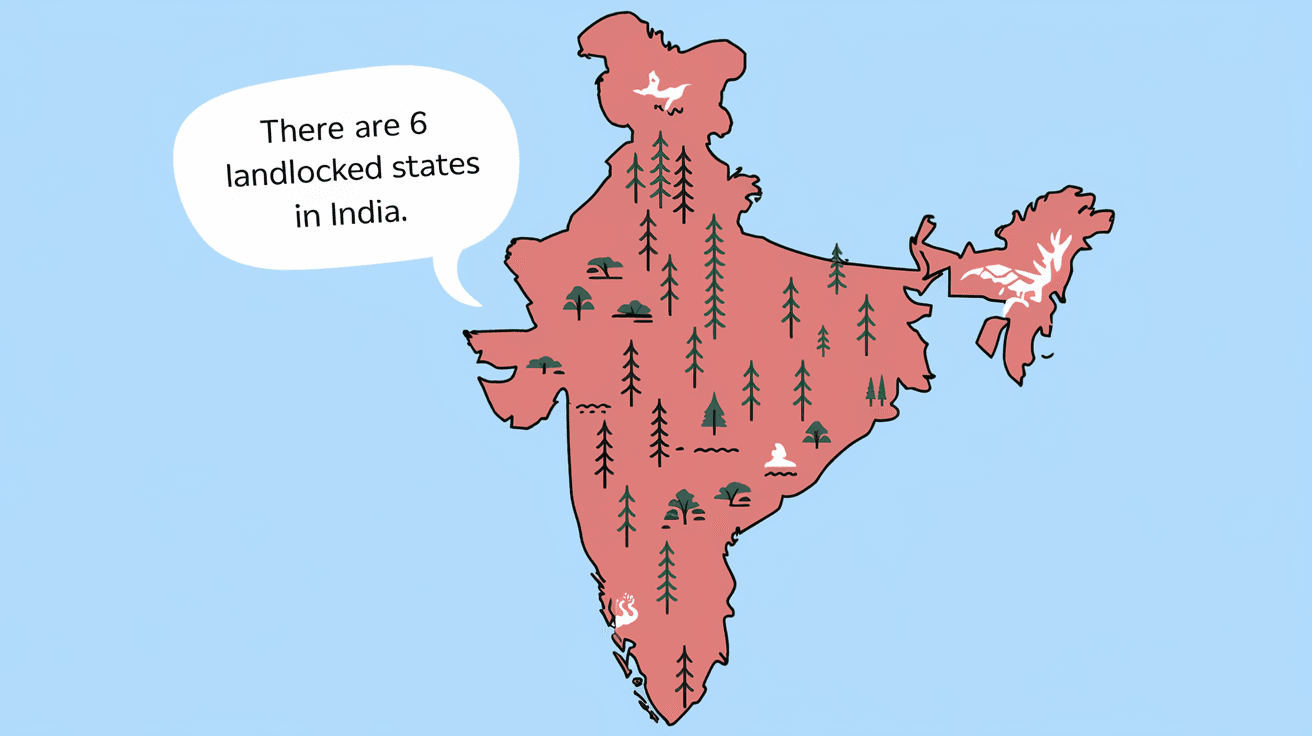
India has a total of 28 states. Out of these, 10 states are landlocked. These states do not have any coastline and are surrounded by other states or countries.
Here is the list of the landlocked states in India:
Each of these states has unique features, but they share the common trait of being landlocked.
You might wonder why it matters if a state is landlocked or not. Here are some reasons why landlocked states are significant:
Understanding these factors helps you see how geography influences the life and growth of these states.
Let’s explore a few landlocked states to understand their geography and significance better.
Rajasthan is the largest state in India by area and is completely landlocked. It borders Pakistan and several Indian states like Gujarat, Madhya Pradesh, and Haryana.
Located in central India, Madhya Pradesh is also landlocked and surrounded by several states.
Haryana is a smaller landlocked state near Delhi.
Jharkhand is rich in minerals and forests but has no coastline.
Being landlocked comes with some challenges that affect development and daily life.
Despite these challenges, many landlocked states have made significant progress by improving connectivity and diversifying their economies.
Landlocked states in India have adopted several strategies to overcome their geographical limitations:
For example, Madhya Pradesh and Rajasthan have invested heavily in highways linking them to ports in Gujarat and Maharashtra. Haryana benefits from its proximity to Delhi, which has excellent transport infrastructure.
Besides states, India has several Union Territories, some of which are landlocked. For example, Delhi is a Union Territory and is landlocked, surrounded by Haryana and Uttar Pradesh.
Union Territories often have different administrative setups but face similar challenges related to being landlocked. Delhi, however, benefits from its status as the national capital and its excellent connectivity.
Landlocked states often develop unique cultural identities influenced by their neighbors. Since they are surrounded by other states, they experience a blend of languages, cuisines, and traditions.
For example:
This cultural diversity enriches the social fabric of landlocked states.
| State | Key Features | Economic Highlights |
| Rajasthan | Largest state, desert landscape | Tourism, mining, agriculture |
| Madhya Pradesh | Central location, mineral-rich | Agriculture, industry |
| Haryana | Near Delhi, industrial hubs | Agriculture, manufacturing |
| Punjab | Agricultural powerhouse | Farming, industry |
| Chhattisgarh | Forests, minerals | Mining, steel production |
| Jharkhand | Mineral-rich, tribal culture | Mining, heavy industry |
| Telangana | IT and agriculture | Technology, agriculture |
| Delhi (UT) | National capital, urbanized | Services, government |
| Uttarakhand | Himalayan state, tourism | Tourism, hydropower |
| Himachal Pradesh | Mountainous, tourism | Tourism, horticulture |
Now you know that India has 10 landlocked states, each with its own unique geography and challenges. Being landlocked means these states do not have direct access to the sea, which affects their trade and development. However, they have adapted by improving connectivity and focusing on diverse economic activities.
Understanding the landlocked states helps you appreciate the diversity and complexity of India’s geography. Whether it’s Rajasthan’s deserts or Jharkhand’s forests, these states contribute significantly to India’s culture and economy despite their lack of coastline.
India has 10 landlocked states that do not have any coastline or direct access to the sea.
Rajasthan is the largest landlocked state in India by area.
Yes, landlocked states often face higher transportation costs and depend on neighboring states for port access.
Yes, they export goods but rely on road and rail links to coastal ports for shipping.
Yes, Delhi is a landlocked Union Territory surrounded by Haryana and Uttar Pradesh.