

How Many Hours Difference Between India and London
F
Discover verified facts, data, and insights about India’s states, culture, economy, education, and more — all in one place at FactBharat.
Search for a command to run...
Discover verified facts, data, and insights about India’s states, culture, economy, education, and more — all in one place at FactBharat.
No comments yet. Be the first to comment.
Moving to the USA from India is a dream for many. Whether you want to study, work, or live with family, the process can seem complex. But with the right information, you can plan your move confidently. I’ll guide you through the key steps and options...
Opening a college in India is a dream for many educators and entrepreneurs who want to contribute to the country’s education sector. If you are one of those who want to start a college, you need to understand the process clearly. It involves several ...
Opening a hospital in India is a significant and rewarding venture. If you’ve ever wondered how to start one, you’re in the right place. Whether you’re a healthcare professional, entrepreneur, or investor, understanding the process is crucial. You’ll...
Opening a medical store in India can be a rewarding business opportunity. You get to serve your community by providing essential medicines and healthcare products. If you are thinking about starting a medical store, you might wonder where to begin an...
Opening a restaurant in India can be an exciting and rewarding venture. Whether you dream of serving traditional Indian dishes or international cuisine, the process involves careful planning and understanding of local regulations. If you’re ready to ...
FactBharat | Insights About India
2558 posts
Discover verified facts, data, and insights about India’s states, culture, economy, education, and more — all in one place at FactBharat.
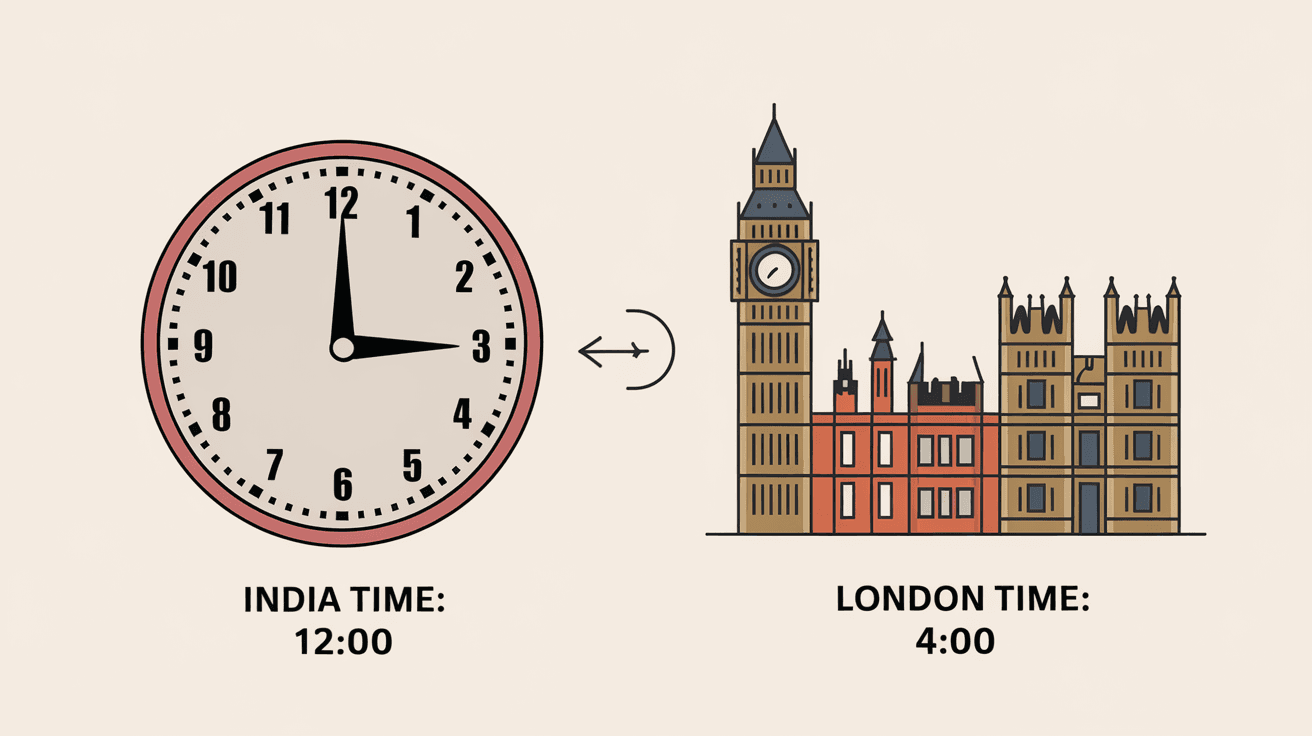
When you’re planning a call, a trip, or just curious about the time difference between India and London, it’s important to know exactly how many hours separate these two places. You might think it’s straightforward, but the time difference can change depending on the time of year. I’ll help you understand how this works so you can plan better and avoid confusion.
In this article, we’ll explore the time zones of India and London, how daylight saving time affects the difference, and practical tips for managing this time gap. Whether you’re scheduling meetings or chatting with friends, you’ll get clear answers and useful advice.
India and London are in different time zones, which means their clocks don’t show the same time. India follows Indian Standard Time (IST), while London follows Greenwich Mean Time (GMT) or British Summer Time (BST) depending on the season.
India’s time zone is fixed throughout the year, meaning it does not observe daylight saving time. London, however, switches between GMT and BST, which affects the time difference.
The time difference between India and London depends on whether London is observing daylight saving time.
This difference is consistent every day during the respective periods.
London switches to British Summer Time (BST) to make better use of daylight during the longer days of summer. This change affects the time difference with India.
During BST, London is UTC +1 hour, which reduces the time difference with India by one hour.
India does not observe daylight saving time because of its geographical location and consistent daylight hours throughout the year. The country lies close to the equator, where day and night lengths don’t vary much across seasons.
This means India’s time remains steady at UTC +5:30 all year round.
If you want to find the current time difference between India and London, follow these simple steps:
| Period | London Time Zone | UTC Offset | Time Difference (India ahead) |
| Late October to March | GMT | UTC +0 | 5 hours 30 minutes |
| Late March to October | BST | UTC +1 | 4 hours 30 minutes |
Whether you’re working with colleagues, planning travel, or chatting with family, managing the time difference between India and London can be easier with these tips:
The time difference between India and London affects many aspects of life, especially business and travel.
The time gap between India and London influences daily routines for people who live or work across these regions.
Understanding the time difference helps you stay connected and avoid frustration.
Several online tools and apps make it simple to check the current time difference between India and London:
Using these tools ensures you always have the correct time difference at your fingertips.
| Aspect | India (IST) | London (GMT/BST) |
| Standard Time Zone | UTC +5:30 | UTC +0 (GMT) |
| Daylight Saving Time | No | Yes (BST: UTC +1) |
| Time Difference (Winter) | — | India is 5h 30m ahead |
| Time Difference (Summer) | — | India is 4h 30m ahead |
| Daylight Saving Start Date | N/A | Last Sunday in March |
| Daylight Saving End Date | N/A | Last Sunday in October |
Now you know that the time difference between India and London is either 5 hours 30 minutes or 4 hours 30 minutes, depending on whether London is observing daylight saving time. India stays on Indian Standard Time all year, while London switches between GMT and BST. This affects how you plan meetings, travel, or stay in touch with people across these regions.
By understanding these time zones and using tools to check current times, you can avoid confusion and make your scheduling smoother. Whether for business or personal reasons, knowing the exact time difference helps you stay connected and organized.
India is either 5 hours 30 minutes ahead of London during London’s standard time or 4 hours 30 minutes ahead during London’s daylight saving time.
No, India does not observe daylight saving time. Its time zone remains constant at UTC +5:30 throughout the year.
London switches to daylight saving time (BST) on the last Sunday in March and returns to standard time (GMT) on the last Sunday in October.
You can use online tools like Timeanddate.com, World Time Buddy, or simply search “time in London” and “time in India” on Google for current times.
The best time is usually late morning in London (around 10 AM to 12 PM) and late afternoon in India (around 3:30 PM to 5:30 PM) to accommodate the time difference comfortably.