

How Many Hours Difference Between India and Canada
F
Discover verified facts, data, and insights about India’s states, culture, economy, education, and more — all in one place at FactBharat.
Search for a command to run...
Discover verified facts, data, and insights about India’s states, culture, economy, education, and more — all in one place at FactBharat.
No comments yet. Be the first to comment.
Moving to the USA from India is a dream for many. Whether you want to study, work, or live with family, the process can seem complex. But with the right information, you can plan your move confidently. I’ll guide you through the key steps and options...
Opening a college in India is a dream for many educators and entrepreneurs who want to contribute to the country’s education sector. If you are one of those who want to start a college, you need to understand the process clearly. It involves several ...
Opening a hospital in India is a significant and rewarding venture. If you’ve ever wondered how to start one, you’re in the right place. Whether you’re a healthcare professional, entrepreneur, or investor, understanding the process is crucial. You’ll...
Opening a medical store in India can be a rewarding business opportunity. You get to serve your community by providing essential medicines and healthcare products. If you are thinking about starting a medical store, you might wonder where to begin an...
Opening a restaurant in India can be an exciting and rewarding venture. Whether you dream of serving traditional Indian dishes or international cuisine, the process involves careful planning and understanding of local regulations. If you’re ready to ...
FactBharat | Insights About India
2558 posts
Discover verified facts, data, and insights about India’s states, culture, economy, education, and more — all in one place at FactBharat.
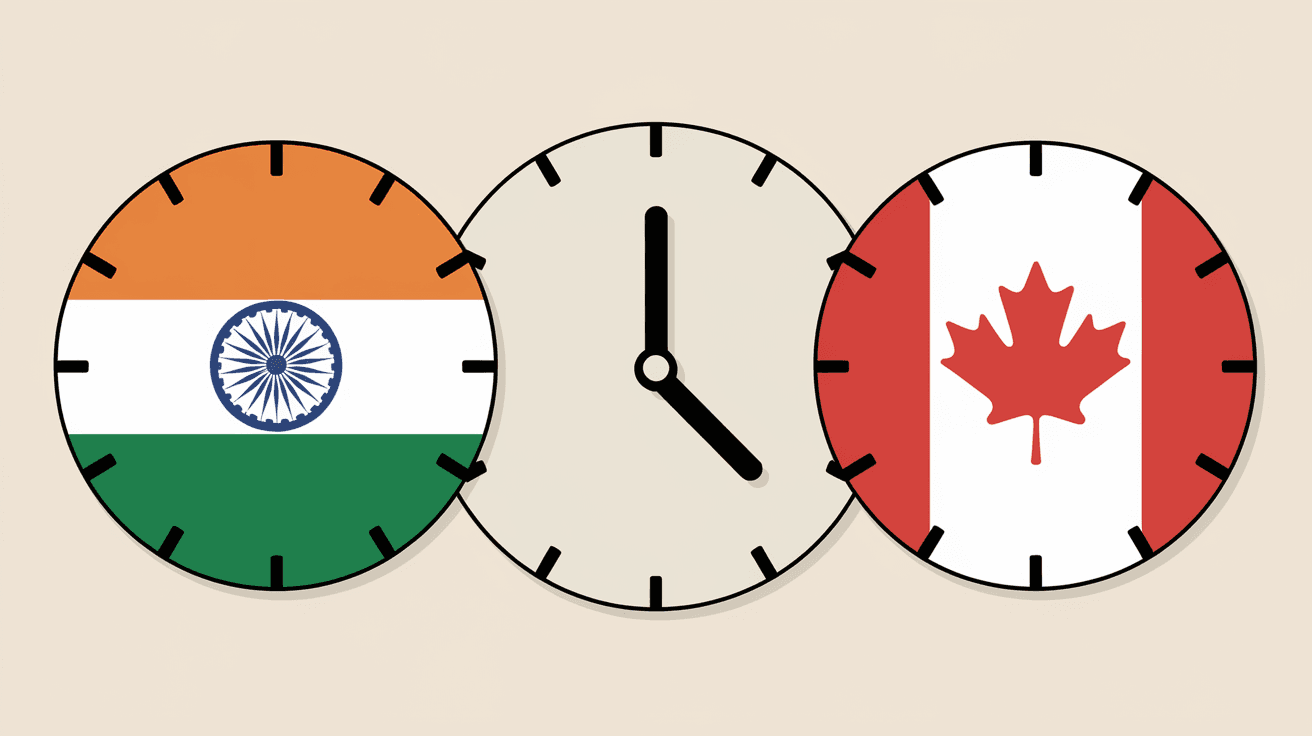
Understanding the time difference between India and Canada is essential if you have friends, family, or business contacts in both countries. Since these two nations are located on opposite sides of the globe, their time zones vary significantly. Knowing the exact hours difference helps you plan calls, meetings, or travel without confusion.
In this article, I’ll explain the time zones of India and Canada, how daylight saving time affects the difference, and practical tips to manage communication. By the end, you’ll have a clear idea of how many hours separate these countries and how to handle the time gap smoothly.
India follows a single time zone called Indian Standard Time (IST). IST is 5 hours and 30 minutes ahead of Coordinated Universal Time (UTC+5:30). This means India does not change clocks for daylight saving and remains consistent throughout the year.
Canada, on the other hand, is a vast country spanning six primary time zones:
Because of this spread, the time difference between India and Canada varies depending on which Canadian time zone you are referring to.
To find the time difference, you subtract the Canadian time zone offset from India’s UTC+5:30. Here’s a breakdown without daylight saving time:
| Canadian Time Zone | UTC Offset | Time Difference with India (IST) |
| Pacific Time | UTC-8 | 13 hours 30 minutes ahead in India |
| Mountain Time | UTC-7 | 12 hours 30 minutes ahead in India |
| Central Time | UTC-6 | 11 hours 30 minutes ahead in India |
| Eastern Time | UTC-5 | 10 hours 30 minutes ahead in India |
| Atlantic Time | UTC-4 | 9 hours 30 minutes ahead in India |
| Newfoundland Time | UTC-3:30 | 9 hours ahead in India |
For example, if it is 8:00 AM in Toronto (Eastern Time), it will be 6:30 PM in India.
Canada observes daylight saving time from the second Sunday in March to the first Sunday in November. During DST, clocks move forward by one hour in most provinces, except for some regions like Saskatchewan and parts of British Columbia.
When DST is active, Canadian time zones shift one hour closer to India’s time:
| Canadian Time Zone | DST UTC Offset | Time Difference with India (IST) |
| Pacific Time | UTC-7 | 12 hours 30 minutes ahead in India |
| Mountain Time | UTC-6 | 11 hours 30 minutes ahead in India |
| Central Time | UTC-5 | 10 hours 30 minutes ahead in India |
| Eastern Time | UTC-4 | 9 hours 30 minutes ahead in India |
| Atlantic Time | UTC-3 | 8 hours 30 minutes ahead in India |
| Newfoundland Time | UTC-2:30 | 8 hours ahead in India |
For example, during DST, if it is 8:00 AM in Vancouver (Pacific Time), it will be 8:30 PM in India.
Here are some real-world examples to help you visualize the time difference:
Toronto (Eastern Time) and New Delhi (IST):
Vancouver (Pacific Time) and Mumbai (IST):
Calgary (Mountain Time) and Chennai (IST):
These examples show how the time difference can vary significantly depending on the Canadian city and whether DST is in effect.
If you regularly communicate with people in India and Canada, managing the time difference is crucial. Here are some tips to help you stay in sync:
Use World Clock Apps: Apps like Google Calendar, World Time Buddy, or Time Zone Converter help you check current times in both countries easily.
Schedule Meetings Carefully: Avoid early mornings or late nights. Aim for overlapping business hours, such as late morning in Canada and evening in India.
Confirm Time Zones: Always specify the time zone when scheduling calls or meetings to avoid confusion.
Consider Daylight Saving Changes: Remember to adjust your schedule when DST starts or ends in Canada.
Use Email and Messaging: For non-urgent communication, email or messaging apps allow asynchronous conversations without worrying about time differences.
You might wonder why India’s time zone is UTC+5:30 instead of a whole hour offset like many other countries. This half-hour difference is historical and geographical.
India’s longitudinal position places it roughly 82.5 degrees east of the Prime Meridian. The 5 hours 30 minutes offset aligns the time zone closer to the country’s center, balancing sunrise and sunset times across the vast nation.
This unique offset means India’s time difference with Canada will always include a 30-minute component, unlike many other countries with whole-hour differences.
Travelers moving between India and Canada often face challenges due to the significant time difference:
Jet Lag: The 9 to 13-hour difference can disrupt your sleep cycle. It’s best to adjust your schedule gradually before traveling.
Flight Timing Confusion: Flight departure and arrival times are listed in local times. Double-check time zones to avoid missing flights.
Business Hours Overlap: If you need to attend meetings soon after arrival, plan your schedule to accommodate the time difference.
Technology Settings: Make sure your phone and devices update automatically to the local time zone to avoid confusion.
| Canadian City | Time Zone (Standard) | Time Zone (DST) | Time Difference with India (Standard) | Time Difference with India (DST) |
| Vancouver | Pacific (UTC-8) | UTC-7 | 13h 30m ahead | 12h 30m ahead |
| Calgary | Mountain (UTC-7) | UTC-6 | 12h 30m ahead | 11h 30m ahead |
| Winnipeg | Central (UTC-6) | UTC-5 | 11h 30m ahead | 10h 30m ahead |
| Toronto | Eastern (UTC-5) | UTC-4 | 10h 30m ahead | 9h 30m ahead |
| Halifax | Atlantic (UTC-4) | UTC-3 | 9h 30m ahead | 8h 30m ahead |
| St. John’s | Newfoundland (UTC-3:30) | UTC-2:30 | 9h ahead | 8h ahead |
This table helps you quickly identify the time difference based on your Canadian location and whether daylight saving is active.
The time difference between India and Canada varies widely due to Canada’s multiple time zones and the use of daylight saving time. India’s fixed UTC+5:30 time zone means the difference ranges from 8 to 13.5 hours depending on the Canadian city and season.
Understanding these differences is key to effective communication, travel planning, and business coordination. Using tools like world clocks and scheduling apps can make managing this time gap much easier.
By keeping these details in mind, you can avoid confusion and stay connected with your contacts across India and Canada without hassle.
India is ahead by 8 to 13.5 hours depending on the Canadian time zone and daylight saving time.
No, India does not observe daylight saving time and maintains UTC+5:30 year-round.
Newfoundland Time has the smallest difference, about 8 to 9 hours ahead of India depending on DST.
During DST, Canadian clocks move one hour forward, reducing the time difference with India by one hour.
Use world clock tools to find overlapping business hours, typically late morning in Canada and evening in India, and always confirm time zones.